Get Full Government Meeting Transcripts, Videos, & Alerts Forever!
Get email alerts on the Land Use topic
No spam. Unsubscribe anytime.
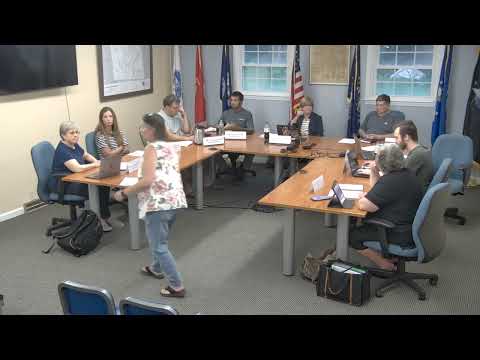
Planning board begins overhaul of subdivision rules: affordability tests, deed restrictions and ADU language debated
Summary
The board reviewed a 07/07/2026 draft of subdivision regulation updates focused on density incentives, how to calculate 'affordable' housing, deed‑restriction timing (five years from certificate of occupancy), a down‑payment standard reduction to 5%, and clarifying ADU and dwelling‑unit definitions.
At its July 7 meeting the New Ipswich Planning Board ran a substantive work session on proposed updates to subdivision regulations, focusing on how to make density incentives meaningful and legally defensible while avoiding unintended zoning conflicts.
Key proposed changes the board discussed included a requirement that lots or units qualifying for density incentives be clearly marked on plans filed with the Hillsborough County Registry of Deeds and a deed restriction that affordable units remain restricted for five years measured from the date of certificate of occupancy rather than from plan filing.
The board debated how to define affordability for incentive calculations. Members discussed using New Hampshire Housing and HUD fair‑market rents as reference points and noted that median household income in New Ipswich (cited at about $104,000 for families in the discussion) and single‑person median figures differ substantially. The draft language under consideration would ask applicants to demonstrate affordability using a mortgage‑based calculation tied to 30% of median income but the board flagged the need to clarify whether mortgage calculations should include taxes and insurance; one board member suggested treating taxes as a fixed percentage of value for simplicity.
On financial assumptions the draft lowers an illustrative down‑payment assumption from 15% to 5% to reflect commonly cited norms for affordable programs. The board also discussed senior‑housing bonus language (defining senior housing as age‑restricted to 55+, with a five‑year deed restriction) and the interplay between accessory dwelling units (ADUs) and multi‑family definitions. Members noted state law prevents ADUs in condominium conversions and discussed how a single property with two ADUs could effectively read as multi‑family in local practice; the board agreed to pick consistent terminology (single‑family, two‑family, three‑family, etc.) to avoid internal conflicts.
Chair asked members to send edits and grammar suggestions to staff and to return with suggested numeric multipliers for affordability calculations. The board did not adopt final language; staff will prepare a revised draft for the next meeting and post materials ahead of the scheduled public hearings in September.