Get Full Government Meeting Transcripts, Videos, & Alerts Forever!
Get email alerts on the Comprehensive Plan topic
No spam. Unsubscribe anytime.
Brainerd Planning Commission reviews comprehensive‑plan updates; consultants warn of major water and wastewater costs
Summary
At a July 15 workshop, consultants presented a first‑draft update to Brainerd's comprehensive plan, reported 67 public survey responses, outlined new map and mobility work, and described multi‑decade water and wastewater projects — including PFAS planning and a roughly $145 million wastewater estimate.
The Brainerd Planning Commission on July 15 received an update on a first draft of the city's comprehensive plan and heard extended briefings on water and wastewater infrastructure needs.
Consultants from Bolton Mink said they reorganized goals and policies to reduce repetition, added policy language on childcare and industrial development, and plan to add new infrastructure maps (sanitary sewer, storm sewer, wastewater, water and transportation) to the document. "We're on the right track as we work on finishing our first draft of the document," the lead consultant said, noting the team will circulate the draft to staff and the commission in advance of a planned September meeting.
The consulting team summarized public engagement results: 67 survey responses, 51% of respondents female, 56% aged 25'44, and representation across income brackets; 30% of respondents reported a disability. The consultants said they focused the public survey on high‑level goals rather than the plan's entire list of more than 100 policies and used the 2024 American Community Survey for demographic updates.
On land use, the consultants said the public prioritized "quality living conditions for all residents" while the commission emphasized a diverse mix of housing choices. Commissioners agreed to keep both a concise chart for regular users and longer descriptive text with photos to improve accessibility for the broader public.
A substantial portion of the meeting addressed mobility and infrastructure mapping. Consultants described a transportation analysis that projects future travel based on the future land‑use map, segments corridors for investment, and will prioritize a top set of corridors for near‑term focus while retaining a complete dataset in the implementation matrix. Commissioners pressed for trails and pedestrian/bicycle facilities to be integrated into the transportation analysis rather than treated solely as recreation assets.
Consultants also outlined the infrastructure chapter and implementation tools, saying the plan will identify programs, fiscal devices, official controls (for example, zoning and subdivision ordinance language), and a timeline with suggested "champions" and resource sources. The team said it will provide the implementation plan in the document and as an editable Excel workbook to support ongoing tracking.
Morgan Salo, principal water/wastewater project manager at Bolton Mink, briefed the commission on water and wastewater facilities. Salo said Brainerd's wastewater plant meets current National Pollutant Discharge Elimination System (NPDES) permit limits but is not configured to meet likely future, more stringent nutrient and PFAS standards. "Today, we're meeting those permit limits," Salo said, adding that the plant would require significant upgrades to address evolving regulatory requirements.
Salo described the scale of potential wastewater work: a biosolids project she identified as an immediate need with a phase‑one estimate of roughly $45,000,000, a phase‑two estimate near $100,000,000, and combined wastewater improvements on the order of $145,000,000 over the next 25 years, according to the facility plan. She emphasized that facility planning must also identify funding strategies and rate structures to keep water and wastewater costs equitable and affordable for residents.
On drinking water, Salo said Brainerd currently draws from six wells drilled between about 1918 and 1983 and that older wells and treatment assets raise operational and replacement concerns. The consultants recommended a siting study and planning for a new water plant so the city can choose treatment technologies, maintain water‑quality goals, and manage rates and debt service.
The meeting included an extended discussion of PFAS compounds. Salo said PFAS can derive from manufacturing, firefighting foam and consumer products and that testing and treatment options vary. "We're talking one part per trillion," she said when describing potential future treatment targets. Salo said centralized PFAS treatment in the liquid stream is expensive and that options can include moving or sealing affected wells, adding point‑of‑use carbon filters in some settings, or adding centralized treatment technologies (granular activated carbon or ion exchange) if required by regulation.
Commissioners asked for more detail on the transportation gap list and for implementation information in the draft, and the consultants said they will deliver the draft with implementation timelines and suggested department or committee "champions" well in advance of the September meeting. The commission moved to adjourn and voiced aye; the consultants thanked the commission and left the meeting.
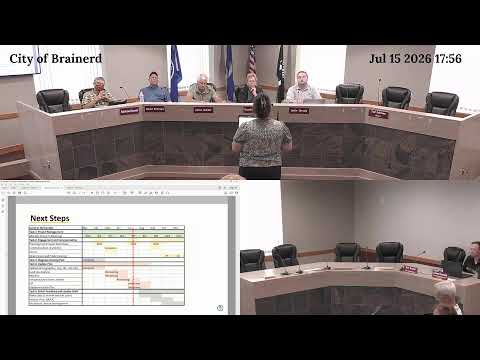
Next steps: the consultants plan to finish the first draft, circulate it for staff and commission review, and return in September for further comment before a likely adoption process in the fall. The consultants also said they will perform an ADA compliance audit of the final document to ensure alt text, color contrast and screen‑reader compatibility.