Get Full Government Meeting Transcripts, Videos, & Alerts Forever!
Get email alerts on the Energy Oil Supply topic
No spam. Unsubscribe anytime.
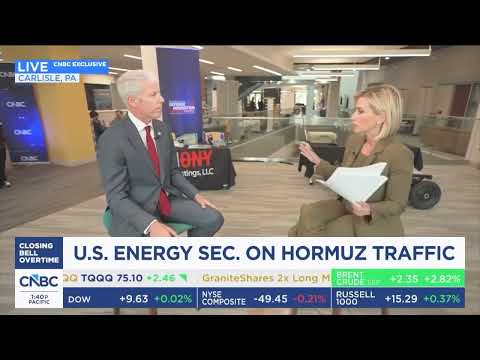
Energy Secretary Chris Wright: 'There will not be tolls' through the Strait of Hormuz as U.S. military secures flows
Summary
Energy Secretary Chris Wright told an on-site interviewer at the Defense and Innovation Summit that a proposed 20% charge on cargo through the Strait of Hormuz is "off the table," and credited U.S. military escorts with keeping oil and refined products flowing from the Arabian Gulf. He gave recent throughput estimates, discussed Strategic Petroleum Reserve drawdowns and urged restoring refining runs to ease crack spreads.
Energy Secretary Chris Wright said at the Defense and Innovation Summit in Pennsylvania that proposals to impose a 20% charge on cargo transiting the Strait of Hormuz are "off the table" and that U.S. military escorts have been assuring the flow of oil and refined products from the Arabian Gulf.
"No. That's off the table," Wright said when asked about a possible toll. He added later, "There there will not be tolls through the Strait Of Hormuz," and credited U.S. military operations—which he said began about two months ago—with enabling continued movement of oil and gas.
Wright gave recent throughput estimates, saying the last few days' flows through the strait were "a little less than 10,000,000 barrels a day" and that "if you add in the incremental volumes going through the pipelines, it's about 15,000,000 barrels a day" coming out of the Arabian Gulf. He contrasted those figures with pre-conflict exports of about "20,000,000 barrels a day." Wright stressed that other producing regions have added output and that the global market is "reasonably well supplied" at present.
Interviewer Morgan Brennan pressed on the near-term price picture, noting Brent near $85 and WTI around $80 per barrel, and asked what policies could lower prices. Wright said the primary lever is growing domestic production—citing potential in Alaska, the Gulf and onshore U.S. resources—and influencing investor sentiment. "We have tremendous potential in Alaska and in The Gulf America. We'll continue to grow our onshore production," he said.
The two also discussed Strategic Petroleum Reserve (SPR) releases and inventory rebuilds. Wright said inventories drawn down by releases will be refilled over time and forecast that more countries, including India and others with limited storage, will develop reserves, producing incremental demand over the coming years.
On refining, Wright described current tightness in refined-product markets and high crack spreads for diesel and gasoline. He said some refiners turned down runs when crude flows slowed, which tightened products markets, and that the United States worked with refiners to limit shutdowns. "So now we've got to get all those players that turn down their refineries to turn them back on," Wright said, calling U.S. refinery output "an all time high." Brennan noted record intraday crack-spread levels earlier in the week.
Asked about Russia, Wright said the country's exports of refined diesel have been sharply reduced by recent measures, telling the interviewer that diesel exports from Russia have "shrunk all the way down to 0," and that combined shocks from Iran and Russia have removed product from the marketplace. He said those disruptions are lifting prices but expressed confidence that prices would fall as conditions normalize.
The interview ended with thanks from both sides. The remarks reflect current administration and industry-focused approaches—boosting supply and encouraging refined-product capacity—to manage prices and availability amid multiple international disruptions.