Get Full Government Meeting Transcripts, Videos, & Alerts Forever!
Get email alerts on the Housing Policy topic
No spam. Unsubscribe anytime.
La Mesa council directs staff to study short‑term rentals and neighborhood compatibility
Summary
Vice Mayor Casares successfully moved July 14 for staff to study short‑term vacation rentals and for a separate review of neighborhood‑compatibility standards; council voted unanimously to direct staff to return with policy recommendations (timeline discussed at six months). Neighbors testified about disruptive activity at nearby short‑term rental properties.
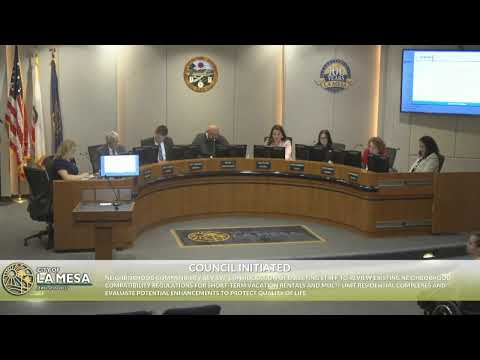
The La Mesa City Council on July 14 directed city staff to study short‑term vacation rentals and to review neighborhood‑compatibility standards, with the goal of returning policy recommendations to the council.
Vice Mayor Casares introduced the items, saying La Mesa currently has no local regulatory framework for short‑term rentals, no registration or permitting requirement, and is not consistently collecting transient‑occupancy tax from those uses. She said a staff study should inventory the local short‑term rental landscape, engage stakeholders, review best practices in comparable cities, and evaluate operational standards, permitting, enforcement, fiscal impacts and options to collect transient‑occupancy tax.
Two neighbors spoke during public comment. Britney Siminski said a house on her narrow private driveway had begun operating as a short‑term rental advertised for up to 16 guests; she described increased traffic, parking congestion, late‑night noise, safety concerns and repeated interference with residents’ access. "Short‑term rentals fundamentally alter the character of our community by introducing a revolving population of transient occupants," Siminski said, and urged the council to adopt permit and occupancy limits, safety inspections and meaningful notice to adjacent owners. Anne Knox, who identified herself as a neighbor of Siminski, echoed the call for local regulation, saying living next to a short‑term rental can be disruptive.
Councilmembers discussed balancing the interests of responsible, owner‑operated rentals that bring tourist dollars to local businesses against a small but harmful set of bad actors. Councilmember Lothian and others noted examples of both responsible hosts and problematic properties. Discussion included potential operational standards (quieter hours, parking limits, occupancy caps), registration and permitting options, host contact requirements, and a voluntary "good neighbor" certification. Vice Mayor Casares said the study should also evaluate incentives that might encourage voluntary compliance and design programs that support neighborhood compatibility.
Vice Mayor Casares moved to direct staff to study short‑term vacation rentals, develop policy recommendations, and return to the council; the motion was seconded and carried unanimously. Council also approved a related motion to review neighborhood compatibility regulations (including consideration of a Good Neighbor Certification), with a staff return timeline discussed at approximately six months.
Council did not adopt any ordinance that night; the direction was for staff study and recommendations. Staff will conduct stakeholder engagement and legal review, including consideration of state law constraints identified during the discussion, and return with draft policy options for council consideration.