Get Full Government Meeting Transcripts, Videos, & Alerts Forever!
Get email alerts on the Opportunity Zones topic
No spam. Unsubscribe anytime.
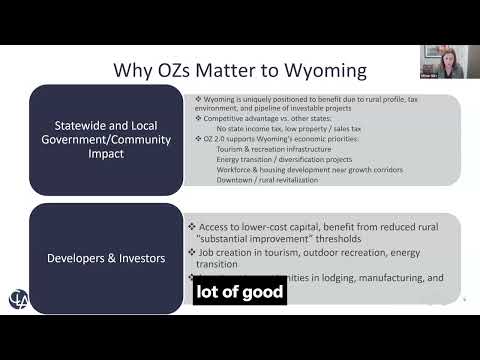
Wyoming officials outline Opportunity Zones 2.0, seek community input ahead of September nominations
Summary
State officials and consultants explained Opportunity Zones 2.0 benefits—especially new rural incentives—and urged communities to submit project evidence and coordinated nominations ahead of an end-of-September governor submission deadline (possible 30-day extension).
Seth Alvestad, a policy adviser in Governor Gordon’s office, opened a state-hosted webinar on Opportunity Zones 2.0 and said the session would explain how the program works, what changed since 1.0 and how Wyoming will nominate census tracts to the U.S. Treasury.
“The goal today is to provide you with a brief overview of Opportunity Zones 1.0, the differences between 1.0 and 2.0, how Opportunity Zone tracks are designated, and where the working group is in providing information to the governor for his ultimate recommendation to the US Treasury,” Alvestad said at the start of the webinar.
Allison Slife, principal with CliftonLarsonAllen, reviewed the federal tax mechanics that underlie Opportunity Zones and described the program’s investor incentive: by reinvesting capital gains into qualified opportunity funds (QOFs) within designated tracts, investors can defer and reduce capital gains taxes and, after a long holding period, exclude appreciation from federal capital gains tax. “It allows them the ability to defer and reduce capital gains taxes by being able to reinvest those into qualified opportunity funds,” Slife said.
Why 2.0 differs: transparency and rural focus
Slife said Opportunity Zones 2.0 tightens reporting and shifts the program from a one-time tax incentive toward a longer-term economic tool with more public reporting than 1.0, which made it hard to evaluate effects. She noted that researchers saw housing as a primary area of investment under 1.0 and said more transparent reporting under 2.0 should make impacts easier to measure.
A central change under 2.0 is new, enhanced incentives for rural tracts. Slife described “qualified rural opportunity zones” as tracts typically outside urban areas (she cited the 50,000‑population threshold as the rural boundary) that are eligible for stronger basis step-up benefits—up to a 30% basis step-up in some circumstances—making rural investments comparatively more attractive under 2.0.
State role, map and qualifying criteria
Connor Christiansen, economic policy and research advisor with the Wyoming Business Council, said the state’s role is to nominate tracks to Treasury using ACS five‑year census-tract data and margin-of-error analysis. He detailed the two eligibility pathways he’s using to evaluate tracts: a tract can qualify if median family income is 70% or less of its comparison area, or if a tract has a poverty rate of at least 20% and meets adjusted median‑income thresholds.
Christiansen demonstrated an interactive map on the Wyoming Business Council site and explained the state’s strategy: Treasury recommended roughly 20 tracks (shown in green on the map); Wyoming may nominate up to 25. The working group identified additional candidate tracts (purple on the map) that are closest to qualifying based on margin‑of‑error analyses; orange tracts lie outside feasible margin adjustments. Christiansen said the team aims to identify about five to eight purple tracks to push for nomination and to gather project-level evidence that will make a quantitative case to Treasury.
Deadlines, usage and community engagement
Christiansen confirmed the nomination window opened July 1 and that nominations must be submitted by the end of September, with a 30‑day extension possible to the end of October. If selected by Treasury, the new 2.0 map and its tied incentives would become effective Jan. 1 and remain fixed for 10 years.
Christiansen emphasized that Opportunity Zones are a federal investor tool—not a direct state funding stream—and that being designated does not guarantee a project. He advised communities to coordinate city/county/EDO input, engage regional Wyoming Business Council representatives, and, when possible, present developer-backed projects or an existing pipeline that shows realistic near-term capital readiness.
Practical constraints and FAQs
On tract boundaries, Christiansen said Treasury will not move technical census-tract borders for small local requests: “You can’t change them,” he said, explaining communities may need to nominate adjacent tracts if broader coverage is needed. He also stressed that the working group will take community input, project evidence and margin-of-error analytics into account when deciding which purple tracks to push for nomination.
Next steps and resources
Slife and Christiansen said slides, links and the webinar recording will be posted on the Wyoming Business Council opportunity zones page; Slife also announced an investor-focused webinar scheduled for Aug. 25. Residents and community representatives should contact their regional Wyoming Business Council representative or Christiansen directly to submit data, project descriptions and coordinated recommendations ahead of the September submission window.
The webinar closed with an appeal for coordinated submissions and a reminder to complete the post‑webinar survey and to use the upcoming investor session to connect projects with potential capital.