Get Full Government Meeting Transcripts, Videos, & Alerts Forever!
Get email alerts on the Utility Regulation topic
No spam. Unsubscribe anytime.
Montana PSC rulemaking on House Bill 55 draws praise from utilities and warnings about model bias
Summary
At a June 2, 2026 Helena rulemaking hearing, the Montana Public Service Commission reviewed proposed rules to implement House Bill 55 requiring independent evaluators for utility competitive solicitations. Utilities said the draft provides needed clarity; independent producers urged stronger safeguards against modeling bias and more time for evaluator review.
HELENA — The Montana Public Service Commission on June 2 held a rulemaking hearing on proposed rules to implement House Bill 55 that would establish a vetted list of independent evaluators and set rules for their selection, scope and compensation.
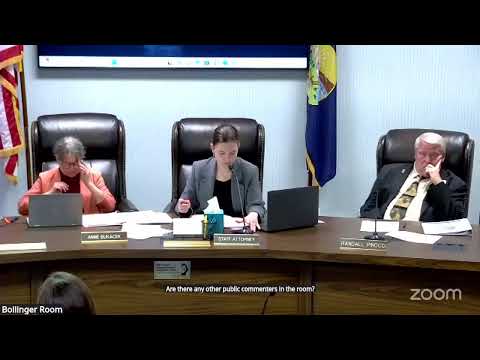
Amanda Webster, chief legal counsel for the Montana Public Service Commission and Department of Public Service Regulation, opened the hearing in the commission’s Bollinger Room and said the commission must adopt implementing rules by July 1. Webster noted the docket number for the matter is 2025.08.058 and that the notice of proposed rulemaking was published May 8, 2026 in the Montana Administrative Register.
Three in‑room commenters addressed the draft rules. Michael Ooda, representing Hydrodynamics Inc., said the proposals are “a good start” but warned they could fail to prevent modeling practices that favor utility‑owned resources. “Right now, our concern for a long time about PowerSim is it’s a black box,” Ooda said, arguing that past modeling and the Mitsubishi work for the commission have shown a bias toward utility investment that can disadvantage qualifying facilities. He said his clients had documented a “significant pattern of underpayment to qualifying facilities.”
Ooda urged several specific changes intended to protect independent generators: explicitly protecting statutory purchase rights under ARM 38.5.2020; prohibiting artificial capacity ceilings and nonmarket penalties under ARM 38.5.2024; requiring utilities to provide fully unredacted transfer capability data and ATC calculations within 15 days of filing; and mandating independent third‑party audits of interconnection risk multipliers and QLAG inputs under ARM 38.5.2032. He also warned that new large single‑load requests — “somewhere in the neighborhood of 1,000 to 1,400 megawatts,” he said — could distort planning economics.
Anne Hill, speaking on behalf of Northwestern Energy, said the proposed rules are “generally aligned with House Bill 55” and provide clearer guidance for regulated utilities. Hill asked the commission to clarify a remaining term that appears to conflate a “3rd party administrator” and an “independent evaluator,” requesting that the commission use the term “3rd party administrator” in the one remaining place where that wording is needed. She also urged the commission not to make changes outside the scope of House Bill 55.
Diego Bridal, representing the Northwest and Intermountain Power Producers Coalition (NIPSI), told the commission his organization supports the rules as an implementation of House Bill 55 but urged stronger separation in cases where a utility’s self‑owned resource could be an RFP outcome. “A simple change of the word ‘should’ to ‘shall’ would more effectively implement … a level playing field,” Bridal said. He also said the commission’s timeline for selecting an independent evaluator — requiring selection within 30 days of a utility’s notice of intent to draft a solicitation — may not leave sufficient time for contracting and meaningful early review by an evaluator.
No action was taken at the hearing. Webster closed the in‑room comment period, invited additional written comments through the docket, and reminded attendees that written public comments may be submitted through June 5, 2026 at 5 p.m. The hearing was adjourned at 10:30 a.m.
What’s next: the commission will accept written comments through the deadline and continue rule development in the docket identified during the hearing.