Get Full Government Meeting Transcripts, Videos, & Alerts Forever!
Get email alerts on the Energy Policy topic
No spam. Unsubscribe anytime.
Lake County supervisors direct staff to draft energy policy, seek consultant for general-plan element and pause CCA consideration
Summary
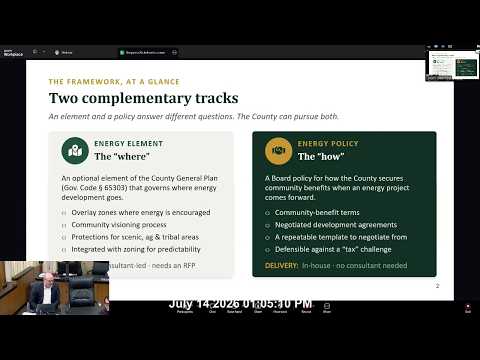
Supervisors instructed staff to hire a consultant to develop an energy element for the general plan, asked Community Development to draft an internal energy policy and return with a 60‑day draft, and agreed to pause Community Choice Aggregator consideration while state and appellate PCIA matters proceed.
Lake County supervisors on the dais on an item prompted by the ad hoc Energy Policy Committee directed staff to seek a consultant for an energy element of the county general plan, asked county staff to prepare an internal energy policy for board review within about 60 days, and agreed to pause consideration of Community Choice Aggregator (CCA) membership while state regulatory and appellate issues involving the power charge indifference adjustment (PCIA) are pending.
Deputy County Administrative Officer Ben Rickelman told the board the committee recommends adding an optional energy element to the general plan and that Community Development would issue an RFP and lead the community‑visioning process, with economic development funds covering the consultant work. "The committee's recommendation is to pursue this," Rickelman said.
The action responds to growing developer interest in a range of energy projects, Rickelman said, though he told the board only one large commercial project — the Morgan Valley wind proposal from Jiminy Development — is currently undergoing CEQA review. He also warned that some projects may use state permitting pathways such as the program the county referred to as "AB205," and that having a local framework would make the county better prepared to negotiate community benefits.
Several supervisors stressed that the ad hoc's work must prioritize policy drafting over private briefings with developers. Supervisor Crandall told colleagues he was concerned that committee members meeting with developers outside their districts could create conflicts and asked that staff or the district supervisor be the primary point of contact: "I feel that has a future potential conflict," Crandall said. Crandall also urged stronger local ordinances, updated geothermal setbacks and, if needed, a temporary moratorium to buy time while rules are put in place.
Community Development Director Mireya Turner said the committee’s original focus had been CCA policy and that, to date, CDD had not received data‑center permit applications: "We have not had any inquiries regarding data centers," Turner said. She added that committee meetings do not confer regulatory approvals and that developing an energy element could take up to a year.
Members of the public largely urged faster work on a county energy policy and asked the board to consider moratoria or stricter protections. Tom Lasik, a resident who addressed the board during public comment, said the ad hoc had failed to deliver the promised policy and urged the supervisors to "come up with the darn energy policy like you said you were gonna do." Online commenter Sterling and other residents called for a moratorium on data centers; several speakers highlighted concerns about groundwater, geothermal impacts and community benefits.
On the CCA question, Rickelman and board members cited ongoing litigation and a CPUC rulemaking (referred to in the meeting as "track 3") that could materially change PCIA calculations. Rickelman and others said they do not expect rulings until around 2027 and recommended pausing any decision on CCA membership until those proceedings conclude.
As an immediate next step, the board agreed — by consensus rather than a recorded roll‑call vote — to: (1) proceed with an RFP for an energy element to be funded from economic development funds and managed by Community Development; (2) have staff continue work on an internal county energy policy and return with a draft in roughly 60 days for additional public review; and (3) pause consideration of joining a CCA while monitoring appellate and CPUC developments on PCIA.
County counsel asked the board to clarify whether staff alone or ad hoc members should continue introductory meetings with potential developers; the board clarified that staff may handle those developer briefings while the ad hoc focuses on drafting policy.
The board did not take a formal vote on an ordinance or a moratorium at the meeting; supervisors said any moratorium would require further legal and procedural work and could be temporary while the county pursues ordinance updates and the general‑plan element. The board directed staff to return with the draft policy and with cost estimates and a proposed RFP timeline for the energy element.
The ad hoc committee and Community Development will now proceed under that direction, and the board will review the draft policy in a future meeting.