Get Full Government Meeting Transcripts, Videos, & Alerts Forever!
Get email alerts on the Mental Health topic
No spam. Unsubscribe anytime.
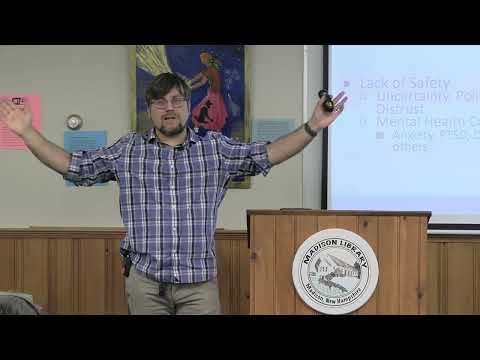
Licensed social worker and state‑house candidate outlines ways to manage anxiety at Madison committee event
Summary
At a Madison and Tannenworth Democratic Committee program, licensed social worker and candidate Brian described the nervous‑system basis of stress and offered practical grounding techniques—paced breathing, ice or hot/cold stimulation, journaling and community activities—to help people cope with chronic anxiety.
Donna Bayou, co‑chair of the Madison and Tannenworth Democratic Committee, opened a community program on stress and anxiety on the evening of the event and introduced the speaker, Brian, a licensed social worker and candidate for state representative in District 30.
Brian told attendees that “anxiety doesn't really care what your politics are,” and framed the evening as a mix of short teaching and group discussion about “what stress is, where it comes from, and more of what we can do about it.” He described stress as an automatic nervous‑system response — the rapid fight, flight, freeze (and a fourth response he called “fawn” or appease) — that can bypass rational thinking when people perceive danger.
Why it matters: Brian stressed that chronic stress is not only an individual problem but often a product of unmet basic needs. Using Maslow's Hierarchy of Needs, he said that lack of safety, food and shelter keeps people in a persistent stress state and cited food insecurity and housing instability in the community as drivers of anxiety.
On the biology and experience of panic, Brian described how the body reacts — faster heart rate, breathing changes, sweating and digestion disruption — and said acute panic often peaks for roughly 15–20 minutes before subsiding. He emphasized that panic can be terrifying but is usually not physiologically dangerous.
Practical techniques: Drawing on clinical practice and hands‑on demonstrations, Brian recommended several in‑the‑moment grounding strategies to interrupt overwhelming thought loops. He suggested intense sensory input (holding an ice cube or using hot/cold water), paced breathing ("breathe in for 4, breathe out for 6"), progressive muscle relaxation, brief intense exercise and focused eye‑movement or bilateral stimulation exercises. He also recommended journaling to ‘‘put the worry somewhere safe’’ and building daily habits — sleep, nutrition, exercise — to support long‑term resilience.
Community and meaning: The presenter linked mental health to social connection and purpose, saying that belonging, volunteering and creative outlets can help people move toward the higher levels of Maslow's pyramid. He referenced Viktor Frankl's idea that a strong “why” can help people endure difficult circumstances and cited group activities such as singing as an example of community‑based stress relief.
Audience exchange: Attendees shared local examples — a school counselor noting students who text rather than speak in a counseling setting, and participants warning about social‑media effects. One attendee described political discourse as a source of chronic stress, saying “The president is always doing something crazy.” Brian and participants discussed the mixed effects of technology and the need to teach social etiquette and face‑to‑face skills.
Next steps and resources: Brian offered contact cards and his website for further information and stayed after the presentation to take questions. The event closed with thanks from Donna Bayou and refreshments so attendees could continue informal conversation.
The session combined clinical explanation, practical coping tools and community suggestions; participants took away specific exercises (ice/hot water, paced breathing, journaling, movement) and a recurring theme that social supports and meaning‑making are key to long‑term resilience.