Get Full Government Meeting Transcripts, Videos, & Alerts Forever!
Get email alerts on the Regional Governance topic
No spam. Unsubscribe anytime.
COG executive director reviews regional transportation, public‑safety and workforce programs for Laurel council
Summary
Clark Mercer, executive director of the Metropolitan Washington Council of Governments, briefed Laurel’s council on regional coordination including TPB/Visualize 2050 planning, commuter services, public‑safety programs and talentcapital.ai job‑matching; he offered technical‑assistance grants and local follow‑up.
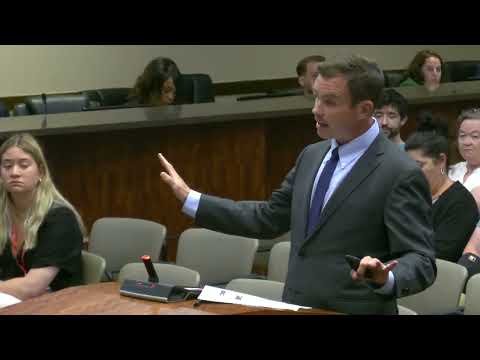
Clark Mercer, executive director of the Metropolitan Washington Council of Governments (COG), told Laurel’s mayor and city council on June 22 that COG’s role is to coordinate transportation, public‑safety and regional economic planning across 24 local governments in the National Capital Region.
Mercer said much of COG’s work centers on transportation planning and federal funding. He explained that the region’s Transportation Planning Board (TPB) compiles a long‑range plan called Visualize 2050 and that projects requiring federal dollars must be included in the TPB plan, which Mercer said accounts for “tens of billions” in potential investments.
Mercer described specific COG programs and services: commuter‑connections and a regional vehicle fleet used for community transportation services; a suite of 28–29 public‑safety programs including mutual‑aid agreements for multi‑agency responses; a real‑time regional crime dashboard intended to deliver operational information more rapidly than annual FBI statistics; and technical‑assistance grants (he noted Laurel previously received a $30,000 grant for the Bowie Road safety audit).
On workforce issues, Mercer promoted talentcapital.ai, a regional job‑matching platform that uses AI to identify active, local job openings and suggest matches based on a user’s resume. He said the tool helps to consolidate job opportunities across jurisdictions and reduce duplication when multiple agencies and employers post similar listings.
Mercer also outlined a planned regional unmanned aerial systems (UAS) detection program, which he said will be implemented next year as a roughly $26,000,000 regional contract, and described COG’s joint procurement and regional funds (public‑safety and environmental funds) that jurisdictions may use for large or shared purchases.
Asked by council members about the Purple Line and local usage of talentcapital.ai, Mercer offered to share data specific to Laurel and to follow up with city staff on procurement and technical‑assistance opportunities.
Mercer concluded by inviting deeper follow‑up meetings between COG staff and Laurel departments on topics such as public safety, transportation, clean air and water, and economic development.