Get Full Government Meeting Transcripts, Videos, & Alerts Forever!
Get email alerts on the Land Use Rezoning topic
No spam. Unsubscribe anytime.
Palm Coast planning board recommends denial of 20,144‑acre Westward Expansion over infrastructure and mitigation gaps
Summary
The Planning & Land Development Regulation Board on July 15 recommended denial of a 20,144‑acre future‑land‑use and rezoning package from Radiant Palm Coast LLC, saying the MPD lacked binding mitigation for roads, schools and county impacts and provided too little guaranteed industrial land relative to proposed housing.
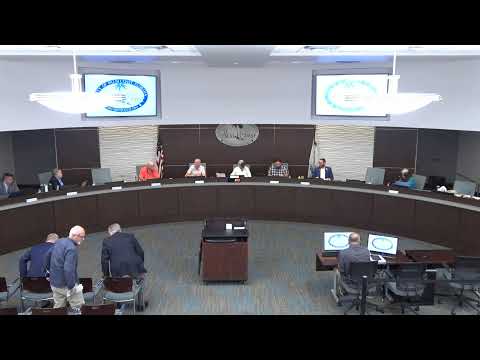
The Planning & Land Development Regulation Board on Wednesday recommended denying a future‑land‑use map amendment and companion rezoning that would have rezoned 20,144 acres west of the FEC railroad to a Master Plan Mixed Use designation and Master Plan Development (MPD).
The board voted 5–0 to recommend denial, citing “lack of information” about how transportation, utilities and school mitigation would be funded and phased. The board’s action is advisory; the items will go to Palm Coast City Council for final decisions.
City staff and the applicant presented the project as a multi‑phase “Westward Expansion” on land owned by Radiant/Rayonier. Senior planner Jose Pampa told the board staff analyzed the applicant’s maximum buildout and found the MPD could entitle about 21,920 dwelling units (a gross population increase staff estimated at about 54,800), roughly 6.6 million square feet of nonresidential uses, and about 28,000 PM‑peak hour trips. Staff also reported projected demands of about 6.3 million gallons per day of potable water and about 5.1 million gallons per day of sanitary sewer. Pampa recommended finding the amendment and rezoning consistent with the comprehensive plan and forwarding them to city council.
The applicant and consultant described the concept as a long‑range plan that includes a greenway overlay to protect wetlands and wildlife, village centers, an employment center and a regional activity center. Ray Spofford of England Thims & Miller said the project would leave more than 50% of the property in recreation/open space and advance regional connectivity, while Mike Hajj, representing the landowner, described the hearing as “step 1” of a process that would move mitigation and facility‑funding details into a later “step 2.” Mike Hajj said: “This is step 1 of a process that’s in front of you today… Step 2 is the public‑facilities mitigation agreements that… are required to be completed prior to development.”
Board members and public commenters pressed for firmer guarantees tying residential buildout to nonresidential and infrastructure delivery. One board member noted that the Employment Center is roughly 564 acres—or about 2.8% of the total project—and said the acreage appeared too small to deliver the industrial jobs the city wants. Staff confirmed the MPD contains a conversion table and phasing provisions, and that development agreements would be required before technical site plan approvals could be issued, but several board members said those provisions did not yet provide enforceable, upfront assurances.
The school district and county told the board they remained concerned. Chris Wilson, an attorney for the Flagler County School Board, warned the board that district estimates showed about 4,400 additional students and about $188 million in impacts, leaving a projected school‑funding gap of roughly $77 million after expected impact fees; he urged the board to ensure mitigation promised under prior DRI agreements would not be lost. Wilson said: “We are very concerned… The issue is 4,400 students, a $188,000,000 impact that we’re seeing for the district.”
Flagler County’s assistant county attorney, Sarah Spector, asked that the county be kept involved and the county letter submitted to the record; County growth director Chuck Miranda requested explicit language requiring a mitigation agreement with the county for impacts on county roads. Spector told the board the county’s review showed the project will have regional effects and asked that county participation be spelled into subsequent agreements.
Residents and the Palm Coast city historian highlighted cultural resources, notably Old Brick Road and other sites that appear in background surveys. Preston Zep, the city historian, said earlier surveys identified cultural resources that merit stronger protections and raised concern that road realignments could jeopardize National Register eligibility of Old Dixie/Old Brick Road.
After extended discussion the board debated options ranging from a formal denial to tabling the items and asking the applicant to return with documented agreements with the school district and county. Legal counsel noted state law requires the planning agency to recommend approval or denial; the board settled on recommendation denials, tying their vote to the lack of sufficiently specific mitigation and enforceable commitments in the MPD agreement.
Votes at a glance - Future Land Use Map amendment to Master Plan Mixed Use (Application 66‑81): recommendation for denial by the Planning & Land Development Regulation Board, vote 5–0. - Zoning map amendment to Master Plan Development with development agreement (Application 66‑82): recommendation for denial by the Planning & Land Development Regulation Board, vote 5–0.
What’s next: The board’s recommendation and the meeting record will be transmitted to Palm Coast City Council, which has final authority to approve, deny or modify the requested comprehensive‑plan amendment and rezoning. Staff said the MPD development‑agreement negotiations and any required mitigation frameworks would be addressed in a later step if the council were to approve land‑use and rezoning changes.
(Reporting note: quotes and factual figures above are drawn from the public hearing record presented to the board on July 15, 2026.)