Get Full Government Meeting Transcripts, Videos, & Alerts Forever!
Get email alerts on the Transportation Regulation topic
No spam. Unsubscribe anytime.
City Attorney's Office proposes ordinance to regulate e‑bikes and motorized wheeled conveyances in Oxnard
Summary
A City Attorney's Office representative presented a draft ordinance to the City of Oxnard committee to define and regulate e‑bikes and other motorized wheeled conveyances, introduce mandatory safety education for cited minors, phase in enforcement over 12 months and align local code with state law.
A representative of the City Attorney's Office presented a draft ordinance to the City of Oxnard Community Services, Public Safety, Housing and Economic Development Committee proposing Article 30 to Chapter 7 of the city code to regulate the operation of motorized wheeled conveyances, e‑bikes and similar devices.
"The city has received complaints regarding unsafe ebike behavior, especially near areas with high pedestrian traffic," the representative said, describing staff work with the Oxnard Police Department and Public Works to craft the draft.
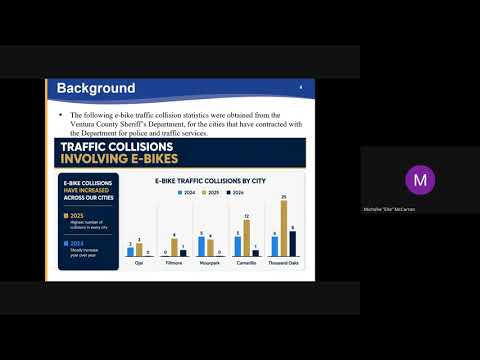
The presenter said local collision data do not separately identify e‑bike incidents, so staff reached out to Ventura County Public Health. "According to the Ventura County Public Health's ebike safety dashboard, ebike injuries have risen more than 70 percent since 2020, with youth ages 10 to 19 representing the largest share of injured riders," the representative said. The presenter also cited a Ventura County Sheriff's Department report noting a steady year-over-year increase in collisions in jurisdictions contracting with the department for police and traffic services.
The draft ordinance would create a broad definition for "motorized wheel conveyance," clarify what qualifies as an e‑bike under state law, and address devices that fall outside existing statutory classes or exceed the 750‑watt limit set by California Vehicle Code section 312.5. It would also specify where such devices may and may not operate, define unlawful operation, set equipment requirements and include specific rules for minors.
Under the proposal, the city would implement a mandatory online e‑bike safety education program for minors who are cited under the ordinance. The ordinance would phase in over 12 months: the first six months would focus on education with no citations or fines, and the following six months would permit citations while allowing cited minors to avoid paying fines if they complete the education program. The presenter noted that violations of the California Vehicle Code would still be strictly enforced throughout.
The presenter pointed to comparable coastal jurisdictions that have adopted similar measures, including speed limits on multi‑use paths, helmet requirements for minors and youth education programs, and said the ordinance strengthens the city's enforcement authority by authorizing penalties and impoundment.
Staff noted several pending state bills that could affect e‑bike classifications, equipment standards and local regulatory authority; the presenter said the draft is intended to align with the California Vehicle Code and may require updates as state legislation proceeds during the ordinance's phase‑in.
The representative recommended the committee review the draft and recommend the City Council introduce it by title only and waive further reading; no formal council action or vote was recorded during the presentation. The committee is scheduled to consider the measure as part of its review process, and staff may revise the draft to reflect changes in state law.