Get Full Government Meeting Transcripts, Videos, & Alerts Forever!
Get email alerts on the SpdI Updates topic
No spam. Unsubscribe anytime.
Wyoming panel hears SPDI updates and moves to draft reciprocity bill amid concerns over OCC preemption
Summary
Wyoming select committee heard operational updates from SPDIs and the Division of Banking, discussed federal OCC trust charters and the Genius Act, and directed staff to draft reciprocity legislation to ease multi‑state money‑transmitter burdens on Wyoming SPDIs.
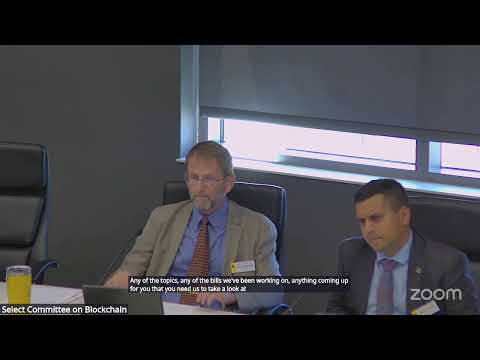
Wyoming's Select Committee on Blockchain, Financial Technology and Digital Innovation Technology spent the morning receiving operational updates from special purpose depository institutions and the Wyoming Division of Banking before agreeing to pursue legislation aimed at interstate reciprocity for money‑transmitter licensing.
The committee heard from a Kraken Financial executive who described growth in its institutional custody business and said the firm recently "received our FedMaster account" and is now working to operationalize it. The witness thanked Wyoming regulators for assistance in licensing and oversight.
Custodia's representative described partnerships with Vantage Bank of Texas and said Custodia has completed multiple proofs of concept for a tokenized dollar, is in the second of four testing stages, and holds patents related to tokenized bank deposits. She also said Custodia filed a cert petition in ongoing litigation and that the company included a damages claim in that case.
Jeremiah Bishop, Wyoming's banking commissioner, framed the committee's central policy problem: Wyoming law treats SPDIs as banks because they accept deposits, but other states' definitions differ (some require FDIC insurance or lending activity). "Banks are exempt from obtaining money‑transmitter licenses," Bishop said, "and since they [SPDIs] don't meet that definition [in some states], they have to get a money transmitter license in those states." He described information‑sharing agreements (notably with Texas) that seek to streamline reviews and examinations.
Committee members pressed witnesses on the appeal of federal OCC trust charters, which some firms are pursuing. Bishop and industry witnesses warned that OCC charters can appear attractive because they may evade some state licensing requirements, but they flagged legal uncertainty over whether OCC trust charters preempt state money‑transmission laws for activities beyond stablecoin issuance. Bishop said states will likely send cease‑and‑desist orders where they believe unlicensed activity occurs.
Given those concerns, the committee directed staff to draft a reciprocity bill to implement a "one license / one exam" approach for qualifying out‑of‑state charters and to include reciprocal enforcement (honor licenses from states that meet specified standards; apply equivalent regulation if they do not). The committee asked the division and staff to develop concrete statutory benchmarks to present at a future meeting.
The committee did not take a formal vote on policy changes during the session; members instead asked staff to prepare legislative language for the next meeting.