Get Full Government Meeting Transcripts, Videos, & Alerts Forever!
Get email alerts on the Paraprofessionals Compensation topic
No spam. Unsubscribe anytime.
Union leaders and council allies press City Council to back pay boost for paraprofessionals ahead of full vote
Summary
Union leaders, paraprofessionals and allied council members urged passage of Intro 692, saying $32,500 starting pay has caused roughly 1,600 vacancies and strained special-education services; organizers said the measure will help retain staff and lower $1.5 billion in annual Carter-case costs.
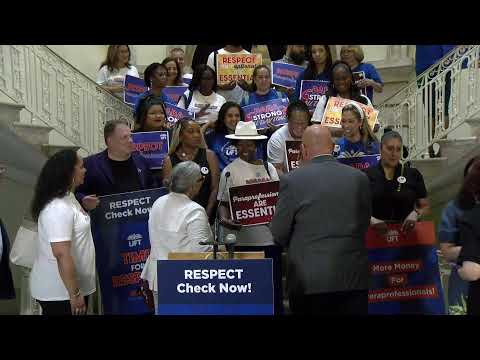
Union leaders, paraprofessionals and several City Council members gathered outside the council chamber to urge approval of Intro 692, a one-time compensation measure for paraprofessionals, as the bill headed to a full City Council vote later that day. Organizers said the raise is aimed at retaining staff who support special-education students and reducing costly litigation.
Julie Menon, identified in the transcript as Speaker of the New York City Council, framed the issue as urgent, saying the city faces about 1,600 paraprofessional vacancies and that starting pay of $32,500 is "shameful" and "unconscionable." She said the council would act because the administration declined other options and noted that the city spends about $1,500,000,000 a year on Carter cases related to unmet special-education obligations.
Carmen de la Rosa, identified in the transcript as the bill sponsor and a council member, said the measure had broad support, with 47 council members signing on. "This is a mandate from the entire city of New York," de la Rosa said, calling the issue one of equity for a workforce that is "predominantly women, predominantly Black, predominantly brown, predominantly immigrant." She described the one-time payment as a practical step to retain staff while collective bargaining continues.
Priscilla Castro, introduced in the transcript as leader of the paraprofessional chapter, thanked members and said the chapter would continue to press for collective bargaining and stable pay. Andrea Polite, who identified herself as a 30-year paraprofessional in District 75, recounted struggles with housing and food insecurity and told the crowd, "I could have left this job and I could have gone and worked someplace else and made more money but I love my students." Katrina Long, a paraprofessional for more than 22 years who said she is a chapter leader, urged the council to "fully fund the Respect check," calling the investment smaller than annual Carter-case spending and necessary to recruit and retain qualified staff.
Shirley Adebowel, introduced as chair of the labor committee that unanimously advanced the bill in committee, said the committee's vote moved the measure to the full council and described passage as "a step in the right direction" to give paraprofessionals greater dignity and pay. Borough presidents Antonio Reynoso and Brad Hoylman also spoke in support, with Reynoso describing personal difficulties finding stable paraprofessional support for his child with an IEP.
Organizers and speakers repeatedly described the need to address vacancies and retention: Menon and others cited roughly 1,600 vacancies reported by the Department of Education and said union surveys suggest the real shortfall may be higher. The speakers stressed the goal of stabilizing a workforce that supports New York City's most vulnerable students and said the measure would not replace collective bargaining but serve as an immediate retention tool.
The event closed with organizers directing attendees to the council chamber across the street, where speakers said the full City Council would vote on the bill later that afternoon. The press briefing did not record a final floor vote outcome.