Get Full Government Meeting Transcripts, Videos, & Alerts Forever!
Get email alerts on the Parking topic
No spam. Unsubscribe anytime.
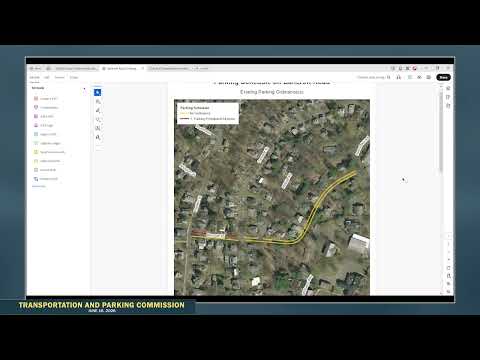
Northampton keeps one‑side parking trial on Bancroft Road after residents report blocked emergency access
Summary
After DPW posted temporary no‑parking signs on one side of Bancroft Road to preserve emergency access, residents and officials recommended trialing the configuration for several weeks, collecting written feedback, and returning a proposed ordinance to the commission for a vote.
The Transportation and Parking Commission on June 16 heard extensive public comment and departmental recommendations after the Department of Public Works temporarily posted no‑parking signage on one side of Bancroft Road to ensure emergency vehicle access.
"We implemented no parking on one side of the street the entire way up," said Donna Escalia, director of public works and chair of the commission, describing the measure as an emergency, data‑driven step intended to stabilize a public‑safety issue rather than a permanent rule.
The action followed resident reports that the street’s narrow width and two‑sided parking have impeded access for fire apparatus and ambulances. "In a medical emergency, paramedics would not be able to access our front walkway without climbing through my garden," resident Jennifer Addis said, explaining why she supports restricting parking to one side and coordinating parking with the presence of sidewalks.
Chief of Police John Cartlidge, who joined DPW staff on a site visit, agreed the street can be obstructed even with a single parked vehicle: "Trying to get a large fire apparatus through there or even a smaller police cruiser would have been difficult," he said.
Several residents told the commission they prefer parking be allowed on the sidewalk side of the street where sidewalks exist and prohibited where there are none. Jason Morley, who lives near the bend, recounted an incident in which paramedics struggled to move a gurney through snowbanks and around parked cars during a relative’s stroke, saying those experiences shaped his plea to adjust the posting to improve access.
Escalia said DPW and enforcement staff are neutral about which side ultimately remains posted and noted practical constraints — such as curb cuts and fire hydrants — that affect which side preserves the most parking while protecting access. Parking Enforcement Administrator Nancy Forrestal said enforcement is the same regardless of the posted side and reported immediate improvement after the temporary signs were installed.
The commission and staff supported running the trial for a short period, capturing written neighborhood feedback, and then returning a formal proposal. "We can certainly do trials where we post for no parking and then move the signs around and see how it goes," Escalia said, adding that the next time the matter comes before the commission she expects it as a proposed ordinance for a vote rather than an open‑ended temporary posting.
The commission did not adopt an ordinance on Tuesday. Next steps are clear: DPW will continue the short trial, engineering staff will prepare a refined plan, the neighborhood will be invited to submit written feedback, and the commission will consider a formal ordinance based on that evidence and the trial results.