Get Full Government Meeting Transcripts, Videos, & Alerts Forever!
Get email alerts on the Fema Reform topic
No spam. Unsubscribe anytime.
House Transportation panel hears bipartisan push for FEMA Act to speed aid; members also raise politicization concerns
Summary
In a full‑committee hearing, lawmakers and witnesses urged shifting FEMA from reimbursement to upfront grants, streamlining environmental reviews, and allowing estimates for repairs to shorten recovery timelines. Several members accused the administration of diverting FEMA staff to immigration enforcement; the former FEMA administrator urged statutory fixes and stronger execution.
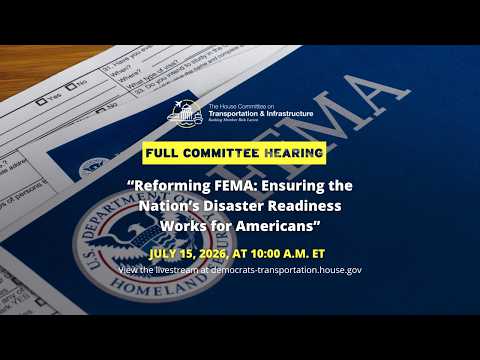
House Transportation and Infrastructure committee members heard nearly five hours of testimony and questioning on July 16 as the panel examined the bipartisan FEMA Act and broader reforms aimed at speeding disaster recovery and strengthening mitigation.
Chair Graves opened by framing the issue as a long‑running problem: repeated reforms have not removed systemic delays, he said, and the committee’s bill aims to make FEMA “state‑led, locally executed, and federally supported.” Committee member Rick told the panel that survivors and local governments too often wait years for reimbursements and said the FEMA Act would establish a universal application and give communities upfront funding to begin repairs.
Former FEMA administrator Fugate, testifying as a witness, urged a survivor‑centered approach and described how using estimates instead of lengthy "actual cost" project worksheets in past disasters sped recovery. “The earthquake takes seconds. The paperwork shouldn’t take decades,” Fugate said, arguing that moving to upfront, project‑based grants and allowing reasonable estimates for debris and emergency work would get money to communities faster.
Local and industry witnesses described how delays affect public and private recovery. Cynthia Lee Chang, parish president of Jefferson Parish and co‑chair of the National Association of Counties’ intergovernmental disaster reform task force, urged converting public assistance from a reimbursement model to a formula‑based grant so counties do not have to borrow to cover immediate costs. “For small counties, signing a debris contract can be beyond their budget,” Chang said.
Jim Matheson of the National Rural Electric Cooperative Association and Brian Waller of the National Association of Mutual Insurance Companies highlighted sector‑specific effects: Matheson said electric co‑ops often serve sparsely populated areas where damage is locally costly and that the bill’s 120‑day timeline for emergency public assistance would improve restoration planning. Waller and other insurance representatives supported stronger mitigation funding and simpler survivor applications to reduce administrative friction.
Debate over models and safeguards surfaced repeatedly. Industry witnesses and some members criticized the review council’s parametric modeling concept — a rules‑based trigger for payments — warning it could deny funds for real, complex damage that does not fit a narrow model. Fugate and others said a sliding scale of federal cost shares tied to state mitigation actions would better incentivize risk reduction.
Politicization and personnel issues drew pointed exchanges. Multiple committee members cited a subcommittee report alleging FEMA staff and resources have been detailed to immigration enforcement tasks; Rep. Garemendi said using FEMA personnel for ICE operations is “contrary to law.” Fugate responded that statutory discretion in the Homeland Security Act allows staff movement and that changing that practice requires legislative fixes or structural changes such as making FEMA independent from DHS. “If you’re not part of Homeland Security, then the secretary’s authority to transfer staff wouldn’t apply,” he said, while also warning that independence alone won’t fix execution problems.
Members from wildfire‑ and flood‑prone districts pushed mitigation arguments: invest now, they said, to avoid higher future rebuilding costs and worsening insurance affordability. Witnesses pointed to examples — repairing a fire station quickly rather than funding temporary sheltering costs — to show how different authorizations could save taxpayer dollars and get people back into homes.
No formal committee vote occurred at the hearing; members repeatedly urged prompt floor consideration of provisions the panel had already marked up in prior work. The committee previously reported the FEMA Act favorably in September, members noted during the hearing.
The hearing closed after a broad set of questions on mapping, hazard mitigation grant delays, nonprofit grant deadlines, and how to measure outcomes. Chair Graves thanked witnesses and adjourned the committee.