Get Full Government Meeting Transcripts, Videos, & Alerts Forever!
Get email alerts on the Cdbg Rfp topic
No spam. Unsubscribe anytime.
Hamilton County outlines 2026 CDBG nonprofit services RFP, deadlines, priorities and CBDO set-aside
Summary
Hamilton County staff detailed the 2026 Community Development Block Grant (CDBG) nonprofit services RFP, including applicant eligibility (nonprofits serving county residents outside Cincinnati), a $500,000 public-services set-aside with a CBDO carve-out, a $25,000-$125,000 award range, and a July 27 submission deadline.
Hamilton County program manager Jake Berghaus on Tuesday walked nonprofit attendees through the county's 2026 Community Development Block Grant (CDBG) nonprofit services request for proposals (RFP), laying out who may apply, what costs are eligible, important deadlines and changes to scoring and monitoring.
Berghaus, program manager in the Hamilton County Department of Community and Economic Development, said the county's total annual CDBG entitlement this year is about $3.4 million and that the county plans to expand funding for public services by up to $500,000, including a carve-out for certified community-based development organizations (CBDOs). "We want you to pay your staff with our funds," he said, signaling the county's preference for labor and direct-assistance uses over capital or broad indirect costs.
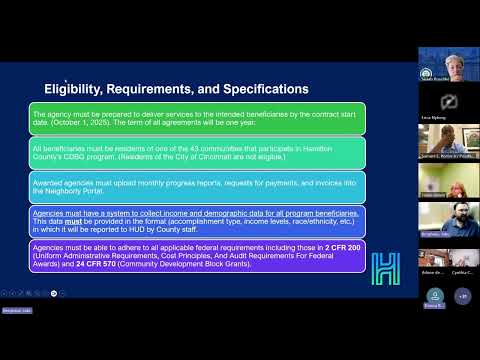
The RFP is open only to nonprofit organizations serving Hamilton County residents outside the City of Cincinnati; organizations may be based in Cincinnati but services covered by the grant must benefit residents of the 43 participating jurisdictions. Berghaus listed four priority service areas that will score more highly: health care; food access and security; education and workforce development; and eviction and foreclosure prevention. Other eligible services (senior services, youth services, childcare, legal services, homelessness services and public safety) remain allowable but will receive lower scoring priority.
Applicants must meet federal administrative requirements, including the Uniform Administrative Requirements at 2 CFR part 200 and Community Development Block Grant program rules, and must be prepared to collect and report income and demographic data for unique beneficiaries. Berghaus emphasized HUD's reporting rules: the program counts unique individuals or households served, not simply the number of services provided. For activities that provide direct monetary benefits (for example, rental assistance), stronger source documentation is required; for many public services, self-certification and other HUD-accepted methods can apply.
The county set application deadlines and a short review timeline: questions are due by July 17 (posted by July 20), full submissions are due July 27 at 5 p.m., staff review will run the week of July 28'31, and recommendations will be sent to the county administrator the week of Aug. 3. Contracts are expected to start Oct. 1, 2026, and run through Sept. 30, 2027. Berghaus said applications must use the county's budget template and must request awards that are program-specific (not agencywide); minimum and maximum award sizes are $25,000 and $125,000 respectively.
On CBDO certification and the set-aside, Berghaus explained that a CBDO must have a defined geographic service area and a governing board that meets criteria (a majority must meet one of three qualifying categories such as low- and moderate-income residents or representatives of neighborhood organizations). The CBDO carve-out in the set-aside will be awarded to certified CBDOs in score order until the set-aside is depleted; any remaining applicants will be evaluated against the general funding pool.
Scoring has been retooled into four categories (project description; budget and financial capacity; organizational information and experience; goals and impact) totaling 100 points, with a 70-point threshold for consideration. Berghaus said scoring will now be handled in-house by county staff rather than by the volunteer CDAC process, which he said will speed decisions.
Berghaus reviewed monitoring and subrecipient responsibilities: subrecipients must upload monthly progress reports and invoices to the Neighborly portal, maintain beneficiary intake and demographic records, keep appropriate insurance, and be prepared for document review of policies, budgeting and service reporting. He warned that indirect costs and major capital purchases are not eligible under this RFP.
During the Q&A, staff clarified documentation standards (60 days of paystubs minimum, 90 preferred; tax documents as best practice), how to report presumed-benefit populations (for example, people experiencing homelessness are reported as extremely low income), and how pass-through providers should obtain partner data for reporting. Berghaus said he will post updated forms, an FAQ Q&A document and links to HUD resources and the CBDO checklist on the program web page.
The workshop closed with a reminder to email questions to staff and a commitment to post the recording, slides and updated beneficiary questionnaire. The county urged applicants to ask clarifying questions early and to ensure budgets are programmatic and complete.
Next steps: applicants should review the posted RFP specs, use the county's budget template, prepare required income and demographic collection systems, and submit questions and full applications by the posted deadlines.