Get Full Government Meeting Transcripts, Videos, & Alerts Forever!
Get email alerts on the Business Impacts topic
No spam. Unsubscribe anytime.
Small businesses and residents say I‑81 work has threatened access and livelihoods; DOT says it will seek solutions but cannot guarantee compensation
Summary
Business owners at a Syracuse Common Council town‑hall-style briefing said repeated closures, lost loading access and unclear outreach have hurt customers and operations; NYSDOT said it will coordinate with city officials but has no general compensation program.
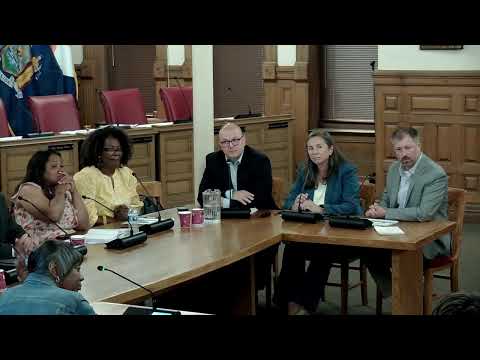
At a Syracuse Common Council briefing about the I‑81 reconstruction, multiple small‑business owners described repeated access losses they say have damaged revenue and operations. Business owners urged NYSDOT and the city to prioritize access windows, better advance notice and targeted outreach to preserve customers during construction.
Tai (Ty) Shaw, who identified himself during the public comment period, said the same driveway area by his uniform shop has been dug up several times in the past 12 months and that business traffic has been repeatedly blocked. “You can't sabotage the people who can't survive,” Shaw said, asking the DOT and council for a plan to keep businesses viable during construction.
Mike Hansen of Hansen Printing told the council the project will remove a long‑used loading dock that sits inside the interstate highway boundary, preventing safe tractor‑trailer deliveries at the rear of his building. Hansen said he was told he could not replace the dock until construction was finished and warned moving or rebuilding will be costly and disruptive after decades of operations at that location.
DOT regional staff acknowledged the harm and apologized for access problems, but they said the department does not run a general compensation program for business impacts caused by highway construction. “We do not, New York State DOT does not have a way to compensate for our impacts,” Betsy Parmley said. DOT staff said they have been contacting businesses directly for encroachment notices and plan more focused, corridor‑by‑corridor outreach as Contract 6 approaches.
Councilors pressed the DOT to coordinate schedules to protect high‑revenue days (for example, university weekends) and asked whether major work could be concentrated on low‑traffic weekdays. DOT said it will step up outreach and suggested working with the mayor’s office and the city engineering department to explore accommodations. The project team also said it will place “open for business” signs where access is constrained and that project outreach staff will walk corridors with engineers to identify specific business needs.
Councilors and residents asked whether the state can offer emergency relief to businesses that demonstrate intractable harm. DOT staff asked affected business owners to report specific instances and to use the project hotline or app so teams can prioritize responses; staff said they will seek administrative or local city assistance where feasible but did not offer a firm compensation mechanism.
The discussion closed with a pledge to pursue practical, case‑by‑case solutions and more direct outreach ahead of major Contract 6 activity, which DOT said could begin as soon as this fall under an awarded design‑build contract.