Get Full Government Meeting Transcripts, Videos, & Alerts Forever!
Get email alerts on the Land Use topic
No spam. Unsubscribe anytime.
Survey presented to Hull Redevelopment Authority finds residents prefer protected open space and oppose housing on HRA land
Summary
Market Street Research told the Hull Redevelopment Authority that a survey of 996 registered voters found strong support for keeping HRA land open and natural, broad opposition to new housing or large commercial development, and interest in community uses such as festivals and farmers markets.
Market Street Research presented results of an online survey to the Hull Redevelopment Authority showing residents overwhelmingly favor keeping HRA-owned land open and preserved for community and nature-based uses rather than developing it for housing or large commercial projects.
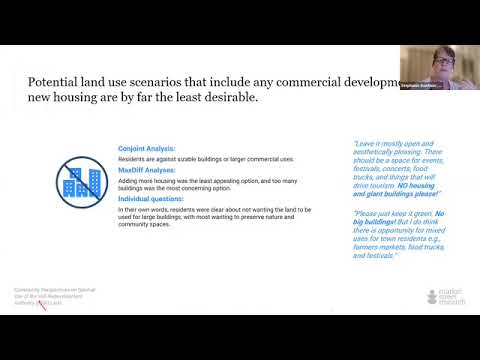
The firm’s president, Stephanie Gonthe, told the five-member board the study collected responses from 996 Hull registered voters between April 20 and May 22, 2026, and used multiple analyses — including conjoint and max-diff techniques — to test trade-offs among possible land-use scenarios. "Residents were clear: they do not want large buildings or housing on this land," Gonthe said.
Why it matters: the HRA’s statutory mission is redevelopment, a mandate that can include selling or developing land. The board faces a policy choice between honoring clear resident preferences for open space and pursuing redevelopment tools that typically rely on revenue-producing uses.
Key evidence and takeaways
- Strong preference for open space: Conjoint and max-diff results ranked "new public open space and parks" and "protecting habitat/green space" at the top of desirable outcomes; Gonthe said those attributes tied for first place.
- Opposition to housing and large buildings: Housing was the single least appealing option in repeated max-diff tasks; scenarios that included large retail, entertainment or hospitality-focused uses consistently depressed appeal.
- Community uses welcomed, with caveats: Respondents favored informal, year-round spaces for farmers markets, festivals and seasonal food vendors but expressed little concern about noise or crowds from such events compared with the loss of open space.
- Funding and implementation remain open questions: Board members queried how to achieve resiliency and amenities without relying on revenue-generating projects that residents oppose. "We’re a redevelopment authority — how do we strike a balance that accomplishes what the survey says people want and what our charter requires?" Chair Bartley Kelly asked.
Reactions and proposed next steps
Board members and residents broadly praised the report’s methodology. Several members suggested the HRA use the survey to complete or revise its urban renewal plan (URP) and to scope work for landscape-oriented professionals. Mark Hammond, a technical consultant to HRA, recommended professionals at the intersection of urban planning and landscape architecture and offered to supervise lower-cost staff or students to implement follow-up work.
Residents and members recommended exploring land-trust arrangements (Wildlands Trust, Trust for Public Lands were mentioned), conservation restrictions and grant-funded resiliency projects. "Keep the land natural and inviting," one resident remark included in the consultant’s report read; another urged space for events but "no more condos."
What the HRA decided
The HRA agreed to accept and post the full Market Street Research report on the HRA website and to discuss next steps at future meetings, including how to translate the survey’s open-space preference into an updated URP, funding strategy and implementation plan. Mark Hammond said he would prepare guidance and share weekly operator reports and other supporting materials with board members.
Sources and provenance
This article is based on the Market Street Research presentation and the board’s discussion presented to the Hull Redevelopment Authority during the meeting (topic introduction: SEG 015; presentation end: SEG 348). Exact quotations and numerical details are taken from the transcript of that presentation and the Q&A that followed.