Get Full Government Meeting Transcripts, Videos, & Alerts Forever!
Get email alerts on the Utilities And Communications topic
No spam. Unsubscribe anytime.
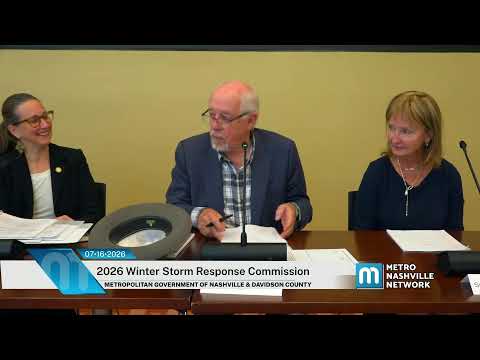
Commission hears public criticism of OEM sheltering, flags NES communication and procurement concerns
Summary
A public commenter and several commissioners told the Winter Storm Response Commission that sheltering guidance was inadequate during the winter storm; the commission also raised concerns about NES communications, procurement transparency, and the scale of outages and workforce surge.
The commission hearing included public testimony from Will Minkoff, who criticized the Office of Emergency Management's (OEM) public messaging and sheltering guidance during a recent winter storm, and an extended discussion among commissioners about Nashville Electric Service (NES) operations and contracting.
Will Minkoff, co-founder of Nashville Severe Weather and an emergency-management consultant, said OEM waited 44 hours from internal recognition of a life-threatening emergency before saying so publicly. He told the commission that families seeking shelter were given inadequate guidance and that OEM's written replies (he quoted responses urging residents to "call 911") and references to 'working with partners' did not help people who had no heat and children at home.
Minkoff said his organization saw numerous health impacts: in a 44-hour span four people were transported to Vanderbilt and by the end of the event more than 50 children were treated at Vanderbilt for carbon monoxide poisoning. He submitted to the commission that OEM adopt professional standards and accreditation and said he would provide his contemporaneous notes in writing to staff.
Commissioners then turned to NES. Johnny Vanderpool and others pointed to the scale of the outage response: at peak roughly 231,000 outages (over half of customers at the time) and an operational surge in line crews from roughly 200'250 on a normal day to nearly 1,700 workers deployed for repairs. Commissioners highlighted command-structure and technology gaps that complicated managing such a surge.
Several commissioners raised public frustration about NES communications and questioned the utility's use of outside public-relations contractors during the crisis. They recommended separating communications issues from technical operations in the interim report and asked staff to link or enumerate the independent after-action products already produced by NES or others.
Procurement transparency was another recurring topic. Commissioners said NES procurement appeared less publicly accountable than Metro processes and asked staff to pursue whether NES contracts could be made visible via the Metro portal. Commissioners also discussed whether emergency declarations (state and local) provide procurement flexibility, with staff noting Metro had declared a local emergency and legal counsel affirming some statutory flexibility exists.
The commission asked staff to compile the NES-related after-action reviews and contract materials already provided in the SharePoint record, to clarify what remains confidential, and to prepare language for the interim report that differentiates operational shortfalls, communications failings, and recommended structural reforms.
The Chair closed the session by asking staff and commissioners to submit outstanding written questions to departments so the interim report can incorporate any additional findings before publication.