Get Full Government Meeting Transcripts, Videos, & Alerts Forever!
Get email alerts on the Markup Overview topic
No spam. Unsubscribe anytime.
House Education and the Workforce Committee advances 10‑bill package to shift Education Department programs to other agencies amid sharp partisan debate
Summary
The committee marked up 10 bills to codify transfers of Department of Education programs to agencies including Treasury, Labor, State, Interior and HHS. Republicans said the moves cut red tape and align programs with agency missions; Democrats warned of funding disruptions, weakened oversight and risks to students and borrowers.
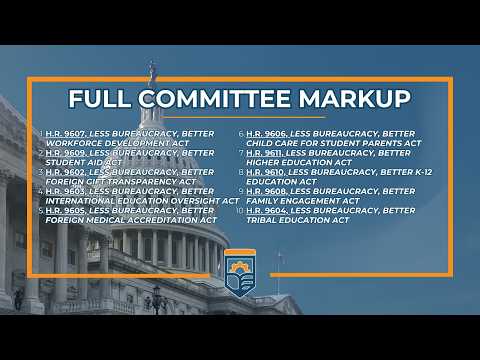
The House Committee on Education and the Workforce opened a marathon markup of a 10‑bill package aimed at permanently moving programs that now sit in the Department of Education to other federal agencies.
Chair Tim Wahlberg framed the package as a set of “first steps” to reduce bureaucracy and better align education programs with workforce and national‑security priorities. He said the proposals — which the committee discussed one by one — would ‘‘empower families, students, workers, and local communities’’ by relocating offices and grant programs to agencies he argued were better equipped to administer them.
Democrats on the panel uniformly opposed the approach, saying the shifts would fragment responsibility, delay payments, weaken civil‑rights and special‑education enforcement, and jeopardize services that millions of students rely on. Ranking Member Scott (identified in the record as the committee’s ranking member) urged members to require independent evidence — GAO studies and agency reports — before making transfers permanent. Several Democratic members described examples of garbled transitions under existing interagency agreements, including delayed payments, IT problems and staffing shortages.
Three items drew particularly intense scrutiny: HR 9607, which would move the Office of Career, Technical, and Adult Education to the Department of Labor; HR 9609, which would transfer the Office of Federal Student Aid and federal student‑loan functions to the Treasury Department; and HR 9610, a broad measure to move numerous K–12 programs to Labor. Sponsors argued those transfers would improve alignment with workforce needs or leverage agencies’ operational capacities. Opponents pointed to a mix of cost estimates, GAO and agency reporting, and a 2015 Treasury pilot that they said showed Treasury struggled with borrower rehabilitation and default collections.
Amendments: Members from both parties offered many amendments that focused on implementation details, reporting requirements, cost estimates and safeguards for students. Democrats proposed delaying implementation until GAO or the agencies certified readiness, required reports on cost and service impacts, sought to protect special‑education and civil‑rights functions from transfer, and demanded assurances that staff and contract issues be resolved. The chair ruled on many amendments by voice; for several contested amendments the chair ordered recorded roll‑call votes that were postponed until a later time.
Votes at a glance (committee action and immediate outcomes) - HR 9607 (OCTAE → Labor): Consideration opened; multiple amendments debated; roll‑call votes on amendments ordered and postponed. Further action postponed. - HR 9609 (Federal Student Aid → Treasury): Consideration opened; extensive debate and numerous implementation/GAO amendments offered; roll‑call votes ordered and postponed. - HR 9602 (Section 117 foreign gift/contract reporting → State): Amendment in the nature of a substitute agreed to by voice vote. - HR 9603 (International education and Title VI/Fulbright programs → State): Amendment in the nature of a substitute agreed to by voice vote. - HR 9605 (Foreign medical accreditation → HHS): Consideration opened; amendments offered; further action postponed. - HR 9606 (CCAMPIS child‑care for student parents → HHS): Consideration opened; amendments offered; roll‑call votes ordered and postponed. - HR 9611 (selected postsecondary programs → Labor): Consideration opened; numerous amendments offered and postponed. - HR 9610 (major K–12 program transfers → Labor): Intensive debate; many amendments proposed (including protections for IDEA, GAO studies and school safety); roll‑call votes ordered and postponed. - HR 9608 (Family engagement → HHS): Consideration opened; amendments on mental‑health and safety funding were offered and postponed. - HR 9604 (tribal education and training → Interior): Consideration opened; members raised concerns about tribal consultation; roll‑call votes ordered and postponed.
Why it matters: Committee Republicans say these bills will reduce duplicated administrative steps and move program management to agencies whose missions better match the programs. Democrats say the bills would institutionalize changes made under interagency agreements that have, they argue, already caused funding delays, administrative confusion and reduced oversight — and that many transfers risk harming vulnerable students and borrowers.
What’s next: The committee recessed after ordering multiple recorded votes; many roll‑call votes on amendments were postponed for later consideration. Several members asked for GAO studies and additional oversight documents to be entered in the record. The bills will proceed through the committee process with the outstanding recorded votes to be resolved according to the committee’s schedule.
Speakers quoted in this report are identified from the committee record: Chair Tim Wahlberg; Ranking Member Scott; Rep. Courtney; Rep. Adams; Rep. Takano; Rep. Bonamici; Rep. Macbeth; Rep. Wilson; Rep. Baumgartner; and others who addressed specific bills and amendments. At the committee’s close, members were given notice that recorded votes would be scheduled and the panel would reconvene after those votes.