Get Full Government Meeting Transcripts, Videos, & Alerts Forever!
Get email alerts on the Information Operations topic
No spam. Unsubscribe anytime.
Presenter says Russia's information operations and 'Max' app deepen control in occupied Ukrainian territories
Summary
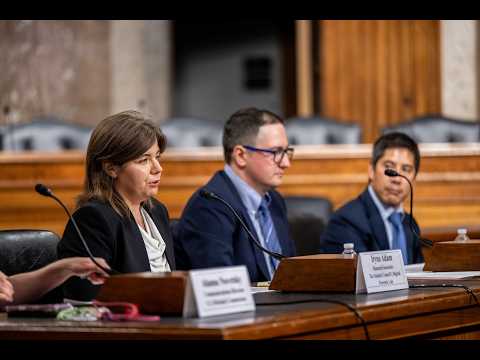
A presenter told the Commission on Security and Cooperation in Europe that Russia combines information blockades, coordinated social-media campaigns and a state-linked app called Max to shape identity in occupied Ukrainian territories and expand surveillance beyond Russia.
A presenter told the Commission on Security and Cooperation in Europe that Russia is combining physical occupation with pervasive information controls and state-linked digital infrastructure to reshape identity in occupied Ukrainian territories and extend surveillance abroad.
The presenter said Moscow's long-term strategy includes a 2036 national-policy goal: "By 2036, the Kremlin wants over 95% of its population to self identify as Russian," and that achieving that aim requires intensive propaganda and information control in Crimea, Donetsk, Luhansk, Zaporizhzhia and Kherson.
The presenter described an "information blockade" in temporarily occupied territories involving phone checks, restricted internet access and blocking of Ukrainian and Western media, which creates a vacuum that Russian-controlled outlets and platforms fill. "Residents were even given free connections to a package of television channels called Russkiy Mir or the Russian world," the presenter said, calling the package an ideological tool to normalize occupation services.
Citing a joint investigation with Ukrainian partner Open Minds, the presenter said researchers "discovered over 3,600 Telegram channels that have sent over 300,000 comments on Telegram between January 2024 and April 2025" targeting audiences in occupied territories. He said some channels posted as many as 1,300 comments in a day and that bot-driven content tailored to occupied-territory audiences promoted pro-Russian narratives roughly twice as often there as elsewhere.
Those narratives, he said, ranged from praise of local infrastructure and social services to repeated attacks on Ukraine's president: "President Zelensky ... appeared in nearly 1 in 6 spot comments," the presenter said, adding that high volumes of aligned comments can create the impression they represent majority opinion.
Beyond content and platform manipulation, the presenter warned of structural changes to digital infrastructure, highlighting a state-controlled "super app" called Max. "As of last year, Max is required to come preinstalled on new phones sold in Russia," he said, and described orders for banks, universities and public agencies to shift away from Telegram and WhatsApp toward Max.
The presenter raised privacy and surveillance concerns tied to Max's data collection and sharing practices, saying the app may collect IP addresses, behavioral metrics and contact information and that its privacy policy allows sharing data with third parties and state agencies. He warned such data could be abused to map diaspora communities, monitor cross-border relationships and facilitate transnational repression.
He also said Russian authorities are running English-language information operations through channels linked to the foreign ministry and that Moscow announced plans to make Max available through telecom operators in about 40 countries, potentially extending Russian digital reach into Latin America, Asia, Africa, the Middle East and Eastern Europe.
The presenter concluded that what is happening in occupied Ukraine is a "structured multilayered system" requiring attention to support Ukraine and protect broader information-system security. The presenter did not state an affiliation during the remarks.
The remarks ended with thanks from the presenter.