Get Full Government Meeting Transcripts, Videos, & Alerts Forever!
Get email alerts on the Psc Ethics Investigation topic
No spam. Unsubscribe anytime.
Montana PSC reviews report substantiating misconduct allegations against Commissioner Brad Molnar; commissioners recess to closed session
Summary
The Montana Public Service Commission on May 6 reviewed a response team report and confidential investigatory findings that investigators say substantiate multiple policy and legal violations by Commissioner Brad Molnar; commissioners questioned counsel about procurement and invoices and then recessed to a closed session to review redacted confidential reports.
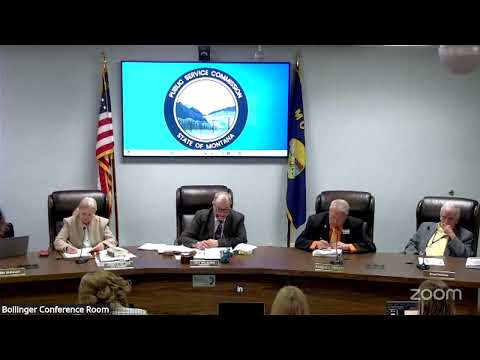
Jeff Welborn, commission president and chair, opened the Montana Public Service Commission meeting at 9 a.m. on May 6 to consider a public response team report and confidential investigative reports concerning Commissioner Brad Molnar.
Amanda Webster, the commission’s chief legal counsel and response team chair, told commissioners the public response team report and related materials were distributed in early May and said the commission would make redacted executive summaries available to members of the public who request them under the PSC’s public information process. "We will be releasing the redacted executive summaries to the public," Webster said, noting the posted report had a clerical correction on May 4.
Amy Christiansen, response team counsel and an attorney with Christiansen Impreza, outlined the investigative process. She said investigators engaged Communication and Management Services (CMS) and conducted two phases of work, which together included roughly 10 interviews in the first phase and additional interviews in the second. Christiansen said investigators reviewed documents, media, and meeting recordings and invited Commissioner Molnar to be interviewed; "He declined" both times, she said.
Jamie Peterson, the commission’s executive director, read a high-level summary of the response team report. Peterson said the investigatory findings cover conduct from Feb. 25 through April 26 and "confirm serious repeated violations of agency policies and state law through independent investigation." Peterson said investigators substantiated multiple policy violations, including unprofessional conduct toward staff, unwelcome comments, and retaliation, and that the matter generated "extraordinary costs exceeding $65,000 in direct expenses" and caused organizational harm. The report recommends that Molnar acknowledge and apologize for misconduct, sign a compliance commitment, complete remedial training, be subject to immediate remote-work requirements, and that the commission consider requesting temporary suspension from the governor if compliance is not demonstrated.
During questions, Commissioner Brad Molnar pressed counsel on how Christiansen was selected and whether her contract was contingent on PSC approval or contained due-process guarantees; Christiansen said she was chosen after a limited solicitation of local attorneys and offered on a reduced government rate. Molnar also pressed about invoicing and payments; Executive Director Peterson read invoice figures from the materials, saying: "Invoices reflect $17,577.91 in charges for work that included meetings with the response team, review of CMS materials and court orders, discovery-related work, and communications with counsel for Commissioner Molnar and the governor." Molnar said he considered the report "a total fallacy." "I find the report to be a total fallacy," he said on the record.
Commissioners also questioned staff engagement and knowledge: Molnar asked Peterson whether he had "personal knowledge" of the incidents beyond having read the reports; Peterson responded that his knowledge for the majority of the content is based on the factual, substantiated evidence provided in the reports and his role on the response team.
After debate over points of order and decorum, Welborn determined that the privacy interests of complainants and witnesses outweighed the public interest for most confidential investigatory material and recessed the public meeting for 10 minutes to convene a closed session to review redacted confidential investigative reports, citing Montana law; Welborn said there would be no public audio or web feed during that time. The commission said it would reconvene in open session afterward to consider three privacy waivers and any potential action based on the response team recommendations.
What happens next: the commission moved into a closed session to review the confidential investigatory reports and deliberate on potential action. Any formal motion or vote on the response team recommendations had not been recorded in the public session prior to the recess.