Get Full Government Meeting Transcripts, Videos, & Alerts Forever!
Get email alerts on the Wildfire Mitigation topic
No spam. Unsubscribe anytime.
Montana PSC hears Montana Dakota Utilities' wildfire mitigation plan; public comment open through April 23
Summary
At a March 25, 2026 public meeting in Sidney and by Zoom, the Montana Public Service Commission heard Montana Dakota Utilities present a brief overview of its wildfire mitigation plan (docket 202507050). MDU outlined a four-tier risk model, targeted inspections and vegetation work, and said it budgeted $2.3 million for 2026; public comment is open through 04/23/2026.
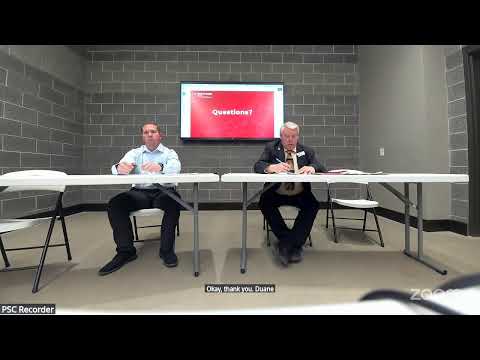
The Montana Public Service Commission convened a public meeting March 25, 2026, at the Richland County Fairgrounds in Sidney and by Zoom to receive a short presentation and public comment on Montana Dakota Utilities’ wildfire mitigation plan filed in docket 202507050. Commissioner Randall Pinocci opened the meeting and commission legal staff summarized the new statutory review process established in House Bill 490.
Pamela Snyder Barnes, commission legal staff, told the commission that HB 490 (now codified in Title 69, Chapter 2, Montana Code Annotated) creates a new process for electric facilities providers to submit wildfire mitigation plans, requires the plan to address specified elements (risk areas, inspection and maintenance practices, vegetation management, deenergization strategies, restoration methods and estimated incremental costs), and establishes a rebuttable presumption that a provider who substantially follows an approved plan acted reasonably in operating its facilities. "HB 490 ... shields an electric facilities provider from certain types of wildfire liability if the provider substantially follows an approved wildfire mitigation plan," she said, and noted the commission must accept public comment for 45 days and issue its decision within 60 days after the close of that comment period.
Christopher James, MDU’s manager of safety management systems and wildfire management, gave a brief overview of the utility’s plan and the tools it will use for prioritization. James said the plan is "important because it reduces wildfire risk" and described a GIS-based "wildfire consequence risk model" that combines three national datasets — the USDA Forest Service wildfire hazard potential, a Rocky Mountain Research Station housing-unit impact dataset, and FEMA’s community resilience index — to identify areas where mitigation work yields the greatest reduction in consequences for people and property. James emphasized the model is a prioritization tool, not a predictor of ignitions, and that it guides where to focus inspections, upgrades and vegetation work.
MDU described a four-tier risk classification (low, moderate, elevated and extreme) to prioritize activity. James said the company will increase inspection frequency and target capital improvements in higher-tier areas while relying on established inspection and maintenance practices in lower-risk areas. MDU also identified four principal components of its plan: inspection and maintenance; vegetation management following ANSI industry standards and danger-tree removal; daily situational awareness during wildfire season tied to SCADA and outage-management systems; and operational protocols including breaker lockouts and assessed work restrictions.
On preparedness and restoration, James said MDU operates within the incident command system when wildfires occur, coordinates with fire agencies and first responders, and uses aerial and ground inspections before reenergizing facilities after an event. He said mutual-assistance agreements allow MDU to bring in external utility crews for large-scale events, and that the company plans more joint drills and public-safety outreach on defensible space and outage preparedness.
Regarding costs and programs, James said, "Over 2026, we've budgeted for wildfire mitigations in Montana up to $2,300,000." He described phased work in early years — focusing on assessments, inspections and engineering reviews to build an inventory and inform later capital projects — and noted current investments in an asset-management system and in advanced power-line-safety settings (EPSS). James also explained public-safety power shutoffs (PSPS) as a last-resort, coordinated action that would require pre-event planning with communities, responders and critical customers.
Commissioner Dwayne Mitchell asked James whether MDU performed similar wildfire-mitigation activities prior to HB 490 and why documentation had not previously been formalized. James replied that many of the activities described in the plan have been carried out for years and that coordination with emergency responders already exists, but that the filing formalizes documentation and helps target future capital work based on the inventory and risk assessments.
The commission asked for public commenters in the room and online; none spoke during the meeting. Commissioners and legal staff reminded members of the public that written comments are being accepted through April 23, 2026, by mail, email (pschelp@mt.gov) or via the commission’s online portal. The commission stated it will consider comments from DNRC and Montana Disaster and Emergency Services as statutorily required, and said it expects to issue final review of the plan on or before June 22, 2026.
The meeting adjourned at about 6:30 p.m. The commission will continue to accept public comments on MDU’s plan through 04/23/2026.