Get Full Government Meeting Transcripts, Videos, & Alerts Forever!
Get email alerts on the Land Use Cannabis Permits topic
No spam. Unsubscribe anytime.
Board grants Pasta Farms appeal in part after applicant drops tree‑removal and new‑building elements
Summary
The Lake County Board of Supervisors granted in part an appeal by Pasta Farms to expand outdoor cannabis cultivation to 30.1 acres, removing permit elements that would have required cutting 362 oaks; the board required revised site plans and a revised project description within 30 days and adopted related conditions to address water, fire and mitigation concerns.
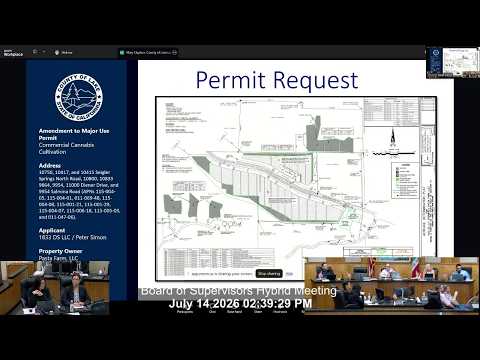
The Lake County Board of Supervisors on July 7 granted in part an appeal by applicant Peter Simon (Pasta Farms/1833 DS LLC) seeking to combine earlier use permits and expand outdoor cannabis canopy to a maximum of about 30.1 acres.
The board’s action followed a staff presentation describing the project and environmental review, an applicant presentation, and hours of public comment focused on oak‑woodland impacts, water availability and wildfire evacuation safety. County staff and the applicant agreed to remove from today’s approval the portions of the application that would require tree removal and construction of new buildings; the board’s approval conditioned the permit on submittal of amended site plans, an amended project description and an amended property management plan within 30 days.
Mary Clabaughn, senior planner for Lake County Community Development, told the board the combined project would increase outdoor canopy from 20 acres to about 30.1 acres and that the initial environmental review identified conversion of about 1.8 acres for nursery and processing buildings, which had been estimated to affect 362 oaks. Staff’s oak‑woodland mitigation analysis proposed planting 1,086 black oaks (a 3:1 replacement ratio) and maintaining them for seven years under the Oak Woodlands Protection framework cited in the staff report. The staff water‑availability analysis (EBA Engineering) estimated the project’s annual demand at 107.37 acre‑feet, about 1.6% of groundwater in storage beneath the site, and concluded the project would not produce an overdraft under the assumptions shown in the report.
Applicant Peter Simon said the site was selected to minimize impacts and described two parts of the amendment: adding roughly 10 acres of cultivation and the proposed buildings. He emphasized that, under the applicant’s amended description, “not a single tree is being removed for the cultivation,” and offered to withdraw the building and tree‑removal components from the approval so those elements could be revised and resubmitted later if they can be located without tree impacts.
Public commenters pressed the county and applicant on several fronts. Speakers representing nearby sanctuaries and community associations urged a site‑specific evacuation analysis and said narrow, historic roads create choke points that could imperil residents and visitors during a wildfire. Multiple speakers and an independent hydrogeologist retained by opponents (Gordon Frau) said the available well data show seasonal water‑level declines that have not fully recovered after pumping, and argued that short pumping tests in fractured rock do not reliably prove a sustainable yield. Others — including local conservation participants — disputed whether planting acorns or seedlings under a seven‑year maintenance plan adequately replaces mature black oaks that can take decades to reach comparable size.
County staff recommended the board reverse the Planning Commission’s denial and adopt modified conditions of approval that reflected the applicant’s concession (removing tree removal and the type‑4 nursery component, and striking conditions tied to construction and grading for tree removal). County Counsel provided motion language to grant the appeal in part, include the staff‑proposed modifications, and require the applicant to submit amended project materials to Community Development within 30 days prior to the board’s final execution of findings. The board approved that motion, 4‑0.
The board’s action does not authorize the applicant to remove trees or construct the buildings that were stricken today. The written permit and conditions must reflect the amended project description and site plans that the applicant will submit; staff said those revised documents must be received before the permit takes effect and that staff will prepare findings of fact reflecting the board’s decision.
Next steps: the applicant must submit the amended project description, amended property management plan and amended site plans within 30 days for staff review as required by the board’s condition; staff will prepare findings of fact and a final decision for the board. Opponents and the applicant both signaled they may continue to provide technical material (hydrology data, arborist clarifications) to CDD for the record.