Get Full Government Meeting Transcripts, Videos, & Alerts Forever!
Get email alerts on the Policy Recommendations Entrepreneurship topic
No spam. Unsubscribe anytime.
Panel tells lawmakers Kentucky needs more venture capital, mentors and business-succession supports
Summary
Presenters told the interim committee Kentucky underperforms on venture capital and high-growth firms and urged policymakers to create unified statewide entrepreneurship supports, mentorship pipelines, incentives for business transfers and workforce internships; legislators raised tourism, education, health care and tax changes as related levers.
Experts who spoke to the interim joint committee on economic development and workforce investment urged a set of policy responses to strengthen Kentucky's entrepreneurial ecosystem, focusing on access to capital, mentorship, workforce pipelines and business succession.
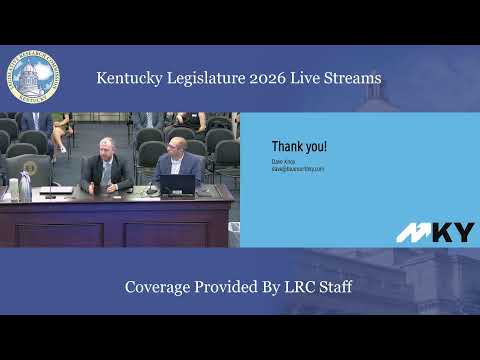
"We have to think about how can we adopt entrepreneur-led economic development as a policy that we truly believe in," Dave Knox, executive director of Blue North, told the committee, arguing the state needs consultative supports, unified branding and targeted programs to help startups scale.
Knox and Chamber staff cited multiple data points: a Secretary of State bulk-data analysis showing a 27% increase in new companies last year but a shrinking share of Delaware-registered corporations (often used as a proxy for VC-backed startups); roughly 190,000 owner-employers facing retirement in the coming decade; and an estimated 79% of those owners lacking a transition plan. Knox proposed building ETA (entrepreneurship through acquisition) infrastructure and regional ETA networks to capture succession opportunities.
Members pressed on complementary levers. Representative Lockett and others asked whether education and tourism relate to higher business dynamism; speakers agreed both are relevant and pointed to K-12 entrepreneurial programming and tourism-driven demand as ways to create market opportunities. Senator Thomas recommended higher tourism spending and airport investment to attract visitors and business activity.
Representative Duvall and other members stressed mentorship shortages; Knox recommended structured mentorship programs that combine learning and outside networks rather than relying only on local volunteers. Representative Layman raised two business-cost concerns: access to affordable health care for founders and a sales-tax burden on R&D supplies and equipment that may disadvantage Kentucky compared with neighbors.
Presenters and legislators discussed existing state levers such as the angel-investor tax credit, the Kentucky Enterprise Fund and statutory changes in recent sessions; no bills were introduced or voted on during the meeting. Committee members asked presenters to follow up with further analysis on industry mix, VC attraction strategies and targeted interventions to retain university graduates and attract out-of-state investors.