Get Full Government Meeting Transcripts, Videos, & Alerts Forever!
Get email alerts on the Rezoning Appeal topic
No spam. Unsubscribe anytime.
Seldovia Board Hears Appeal of City Council’s Denial of Waterfront Rezoning
Summary
Property owners Leslie and Walt Martin appealed the Seldovia City Council’s Feb. 24 denial of a rezoning that would change three waterfront lots from Commercial Business to Waterfront Commercial Residential. The Board of Adjustment heard testimony from the appellants, city staff and members of the public and said it will deliberate and issue a written decision within 30 days.
The Seldovia Board of Adjustment on May 21 heard an appeal by property owners Leslie Martin and Walt Martin challenging the City Council’s Feb. 24 denial of an ordinance to rezone Waterfront Resub Number 1, Lots 2 through 4, Block 13, from Commercial Business District to Waterfront Commercial Residential District.
At the start of the special meeting, Chair Campbell explained the proceeding is de novo and that the appellant bears the burden of proving entitlement to relief. The board set time limits and reminded participants that the record on appeal was the primary evidence but that the board may accept new testimony and give it appropriate weight.
The appellants argued the rezoning request aligned with the city’s 2014 comprehensive plan and with Alaska law. "The best interest of the public seems to be what everybody's talking about most in this whole process," Leslie Martin said, arguing the council’s denial rested on opinion and not on facts showing harm. Walt Martin, who testified for the appellants, disputed the city’s account of prior planning guidance and said the practical effects of rezoning would be minimal: "If there's no development, there's no effect," he said.
A resident who lives adjacent to the disputed property, Walt Sohn, told the board the properties historically were meant for commercial use and urged the board to consider long-term public benefit. "These properties were built on land acquired through the city redevelopment after the earthquake," Sohn said, adding that future generations might view rezoning as a mistake.
City Manager Heidi Gagle, speaking for the city, said the Seldovia Planning Commission and City Council examined the seven criteria in Seldovia Municipal Code chapter 18.97 and found that while criteria 2–6 were addressed, criterion 7 — whether the amendment is "in the best interest of the public" considering cumulative effects on environment, transportation and public services — remained unresolved. "The zoning amendment failed because it did not meet the criteria provided by the Seldovia municipal code to be in the best interest of the public," Gagle said, noting the council received 20 public comments (11 opposed, six in support, three from applicants).
City Attorney Joel Levesque advised the board on ex parte communications and evidence: if new evidence were presented, the board could accept it but should weigh it against the record on appeal. "If any of the parties present new evidence, I would recommend that the board allow the new evidence in, but give it the weight that it deserves," Levesque said.
Much of the hearing centered on competing interpretations of the comprehensive plan and process: the appellants said borough staff instructed them to seek a map amendment; city staff said the proper vehicle and public process had been provided and that alignment with an aspirational comprehensive plan alone does not relieve applicants of the requirement to meet all statutory criteria.
Board members asked procedural and substantive questions, including where the seven criteria originated and how the board should evaluate the practical effects of potential development (for example, parking and building-code implications). City staff acknowledged the comprehensive plan is conceptual and that aligning zoning to a plan can require an extensive code update.
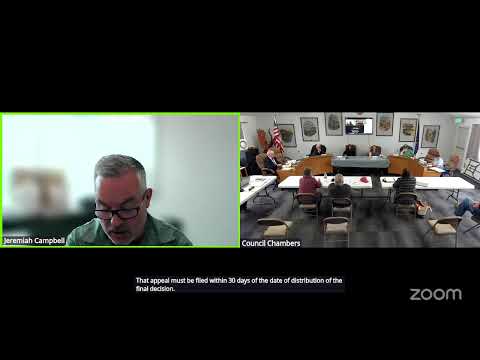
After closing arguments the board voted to adjourn the public portion of the hearing and proceed to deliberations. Chair Campbell said a written decision will be issued and mailed to participating parties and that an aggrieved party may appeal to Superior Court within 30 days of distribution of the final decision.
Action taken at the meeting was limited to procedural votes: the agenda was approved by consensus and the public portion of the hearing was adjourned; the board did not issue a final ruling at the session.
The board’s next steps are to deliberate (in public or in an adjudicated session) and prepare a written decision. That decision will state whether the council erred in applying Seldovia Municipal Code chapter 18.97 when it denied the rezoning request.