Get Full Government Meeting Transcripts, Videos, & Alerts Forever!
Get email alerts on the Wells And Septic Study topic
No spam. Unsubscribe anytime.
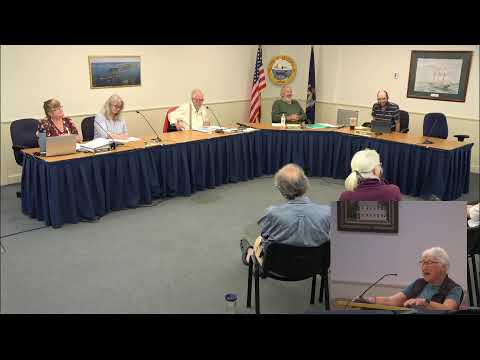
Harpswell approves grant-funded wells and septic survey to map vulnerabilities and guide planning
Summary
The select board authorized a townwide wells and septic survey funded by a 2025 Community Resiliency Partnership grant; hydrogeologist Carol White told the board the project will digitize old 1982 data, map wells and septics into GIS, and could support saltwater-intrusion monitoring and future policy decisions.
Margaret McIntyre, Harpswell’s town planner, told the select board the town received a 2025 grant through the Community Resiliency Partnership to fund an updated wells-and-septic study and an online survey of properties.
"We got this grant to study wells and septics in town," McIntyre said, and introduced Carol White, the contracted hydrogeologist. White described the project as an effort to compile a master dataset that updates work done in 1982 and helps the town identify water-quality and supply vulnerabilities.
"We're trying to update the database to get a current picture of what the conditions are in Harpswell today and we can use that information to sort of predict how future changes might impact your water use," White said. She said well reporting to the state has improved in recent years and that mapping submitted well reports together with town septic records will be valuable for both groundwater and marine-resource planning.
Board members and members of the public pressed staff on logistics. Miriam (a Bowdoin College intern) said the survey will be rolled out online with map-based pin drops linking responses directly to the town’s GIS, and that paper postcards and in‑person help will be available for residents who need them. Lee McElvain, a professional geologist who joined by Zoom, recommended including a category for treatment systems such as water softeners because brine discharge can affect groundwater quality.
Carol White said past surveys in island and coastal towns produced high response rates (60–80 percent) and suggested limiting the answer categories to a few treatment types to make responses easier to process.
After discussion, a board member moved to authorize staff to proceed with the survey incorporating committee suggestions; the motion passed with all in favor. The board and staff said they will provide support for residents who lack internet access and will send letters or postcards to encourage broad participation.
The data collection step is intended to be followed by analysis that could inform future policy or subdivision decisions. White also said, if grant funds remain, the project could support installation of saltwater-intrusion monitoring instrumentation linked to the state’s telemetry network.
Next step: staff will finalize the survey and begin the public rollout, with phone- and in‑office hearing options provided by Vision during the posted appeal window.