Get Full Government Meeting Transcripts, Videos, & Alerts Forever!
Get email alerts on the Solid Waste topic
No spam. Unsubscribe anytime.
Solid Waste Manager Sarah Mason outlines site-plan rules, 30-ft backing limit and cart vs. dumpster guidance
Summary
At a July 14 Planning Commission working session, Solid Waste Manager Sarah Mason summarized how Chapter 26, Article 12 and Chapter 55 shape site-plan review, emphasized a 30-foot maximum backing distance for truck safety, and explained when developers should plan for carts versus dumpsters and what submission materials (generation estimates, swept-path analysis, screening) are required.
Solid Waste Manager Sarah Mason told the Ann Arbor Planning Commission on July 14 that the city’s solid-waste unit oversees collection of trash, recycling and compost for all customer types and that plan reviewers rely on a combination of the city code, a separate regulations document and the Public Services Standard Specifications to evaluate development proposals. "If you have a building and you have people in it, you're going to have trash," Mason said, arguing that collection must be planned for during site design.
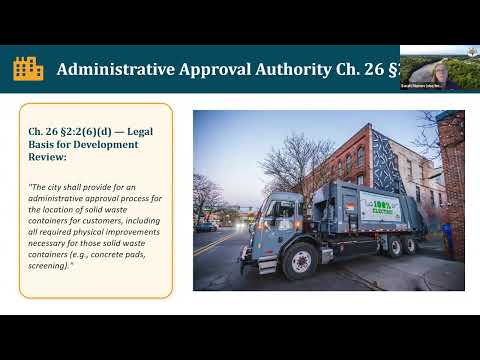
Mason walked commissioners through the principal documents that govern plan review: Chapter 26 of the City Code (the solid-waste chapter), a rules/regulations document that is updated more frequently for technical changes, Article 12 of the Public Services Standard Specifications (dumpster-enclosure dimensions, concrete thickness and swept-path/turning‑radius requirements) and Chapter 55 screening rules for how containers are hidden from view.
She listed the materials petitioners must supply with site plans: an estimate of expected waste generation (use-specific per-bedroom or commercial generation rates), a solid-waste narrative that states the expected service frequency and who will service containers, container sizing and proposed number of collections, swept-path analyses to show truck access, and clear information on where containers will be stored and whether storage is also the point of collection. Mason said recycling in the city is mandatory and is provided at no direct cost to customers, funded by the city’s solid-waste millage.
Mason highlighted safety and operational constraints that shape city decisions. "We do have a 30 foot maximum backing distance, and we do require forward facing access to public streets," she said, explaining the limit is intended to reduce backing-related incidents for collection crews. On cart vs. dumpster choices, Mason described a decision matrix added to recent regulation updates that weighs dwelling type, whether a street is public or private, street frontage and truck accessibility; in many commercial settings, the city assumes a dumpster will be needed, while in residential contexts carts may be appropriate if there is sufficient frontage and access.
Commissioners pressed staff on common downtown constraints and enforcement: Mason said some historic downtown alleys lack vehicle access, leaving businesses with carts instead of dumpsters; the department is exploring screening options and consolidating collection where possible but acknowledged existing buildings and legacy conditions that cannot be re‑designed overnight. She also said multifamily compost collection is available through a contractor and on a review basis rather than as a mandatory service, and that the city leases and contracts operation of the material recovery facility (MRF) to Recycle Ann Arbor and runs a transfer station and a city compost facility at the Wheeler Service Center.
Mason gave a staffing snapshot for city teams: two field supervisors and 19 technicians handle city residential trash, compost and multifamily dumpster collections, with additional contractor crews supporting commercial refuse and recycled‑cart collection. She encouraged commissioners to engage solid-waste staff early in pre‑submittal meetings to avoid designs that later prove infeasible.
The presentation closed with a reminder to petitioners and planners that container location, screening and swept-path access must be integrated into project design so the city can provide safe, reliable collection without creating ongoing conflicts for residents or crews. The commission had no vote on regulatory changes; the session moved on to the Bryant geothermal project afterward.