Get Full Government Meeting Transcripts, Videos, & Alerts Forever!
Get email alerts on the Health Policy Markup topic
No spam. Unsubscribe anytime.
Ways and Means advances package of bipartisan health bills, including caregivers' visitation protections and insurer transparency
Summary
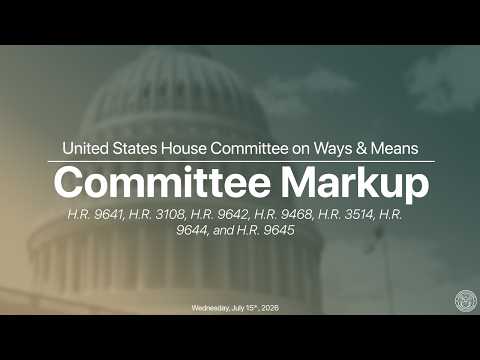
The House Ways and Means Committee on Jan. 1, 2026, advanced a set of bipartisan health bills addressing visitation rights in nursing facilities, remote patient monitoring reimbursements, rural anesthesia access, long‑term acute care policy, prior‑authorization reform and insurer transparency. Most measures were reported favorably to the House after roll‑call votes.
The House Committee on Ways and Means advanced a series of bipartisan health bills during a full committee markup that concluded with most measures ordered favorably reported to the House. Chairman Smith led the session, which included legislative walks through from Patrick Dumas, the Health Subcommittee staff director, multiple rounds of member debate and several recorded roll‑call votes.
The markup opened with a remembrance of former Ways and Means chairman Bill Archer and quickly moved into a package of bills the committee framed as focused on patient access, price transparency and rural health. "We are taking decisive steps to hold healthcare empires accountable and improve the health of our communities," Chairman Smith said as he outlined the agenda.
Representative Claudia Tenney led off with HR 9641, the Essential Caregivers Act, which she described as an amendment to the Social Security Act to require skilled nursing facilities and similar providers to implement an ‘‘essential caregiver’’ program that guarantees in‑person access for up to two designated caregivers when regular visitation is suspended, subject to infection‑control guardrails. "Loved ones are not visitors. They're caregivers, advocates. They're lifelines," Representative Tenney said, urging bipartisan support. After a technical description of the substitute amendment by Patrick Dumas, the committee agreed to the substitute and voted to favorably report HR 9641 to the House (yeses 38, noes 0).
The committee then considered HR 3108, the Rural Patient Monitoring Access Act, sponsored by Representative Kustoff. Dumas described the bill as setting a temporary floor for geographic practice cost indices and clarifying RPM definitions, with a requirement for an outcomes report comparing beneficiaries who receive remote monitoring with those who do not. Representative Beyer offered an amendment to codify oversight recommendations — including requiring clinician ordering information and claims transparency — but the amendment failed on a roll call (yeses 15, noes 25). The committee adopted the substitute and ordered HR 3108 favorably reported (yeses 39, noes 0).
Members debated HR 9642, the Medicare Access to Rural Anesthesiology Act, which would permit certain low‑volume rural hospitals and critical access hospitals to use pass‑through payments for physician anesthesiologists under specified conditions. Supporters said the change helps stabilize rural surgical capacity; critics pressed that the bill targets one specialty and rural hospitals rather than a broader set of safety‑net providers. The committee agreed to the substitute and reported HR 9642 to the House (yeses 41, noes 0).
The markup also advanced the STAR Act (HR 9468), which updates Medicare rules for long‑term acute care hospitals (LTACs) to create a high‑acuity admission pathway and extend site‑neutral payment provisions; sponsors argued the change would reduce unnecessary ICU stays and speed patients to appropriate care. The committee ordered HR 9468 favorably reported (yeses 40, noes 0).
Chairman Kelly and Representative Del Bene led consideration of HR 3514, the Improving Seniors' Timely Access to Care Act, to require electronic prior authorization for Medicare Advantage plans and public reporting of prior‑authorization metrics. Sponsors and many members stressed the administrative burdens on providers and high overturned appeal rates; members voted to report HR 3514 as amended (yeses 42, noes 0).
Representative Moran introduced HR 9644, the Medicare Advantage MLR Transparency Act, to require MA plans to submit and publicly post information about revenues, spending on medical services versus administrative costs and supplemental benefit usage. Debate focused on insurer consolidation, the mechanics of medical loss‑ratio calculations and whether disclosure alone is sufficient; the committee ordered the measure favorably reported (yeses 42, noes 0).
Finally, the committee considered HR 9645, the Healthcare Price Certainty for All Americans Act, a multi‑section package requiring price disclosure by hospitals, imaging and laboratory providers and additional reporting by Medicare Advantage plans. Members offered multiple transparency and AI‑related amendments; several were rejected on roll call. The substitute was agreed to and the committee voted to report HR 9645 to the House (yeses 25, noes 15).
What the committee did and what happens next
- Formal actions: For each bill the committee adopted an amendment in the nature of a substitute (where noted), then voted on motions to favorably report the measures to the House. The clerk reported final tallies in each roll call listed above; those tallies are recorded in committee minutes and summarized here. Representative Buchanan moved the committee motions to report multiple bills to the House.
- Implementation and follow‑up: Staff were authorized to make technical and conforming changes to the bills, and members were given two additional days to file supplemental or dissenting views with the committee clerk.
Key points of contention
Democrats repeatedly raised concerns that the majority's broader policy choices have reduced coverage and stressed the need for more comprehensive solutions to rural and safety‑net shortfalls, arguing targeted fixes do not fully address systemic coverage losses. Ranking members pressed contexts such as Medicaid cuts and solvency concerns. Republicans emphasized transparency and market access, framing the package as patient‑focused reforms.
The committee adjourned after reporting the measures to the House and authorizing staff technical edits. The bills advanced by the committee will next be considered on the House floor or referred for further floor scheduling, depending on the majority's calendar and leadership decisions.
Quotes used in this report are drawn directly from the committee transcript and have been attributed to the speakers who made them.