Get Full Government Meeting Transcripts, Videos, & Alerts Forever!
Get email alerts on the Tax Increment Financing topic
No spam. Unsubscribe anytime.
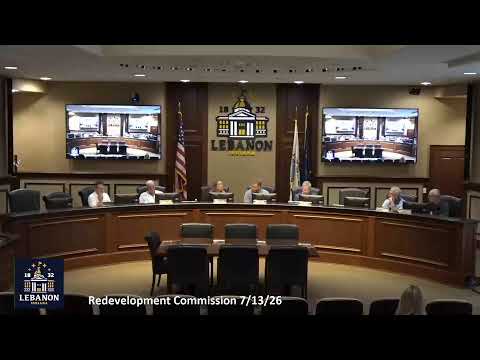
Baker Tilly presents TIF annual report to Lebanon redevelopment commission; industrial park, field house revenues and expirations highlighted
Summary
A Baker Tilly consultant told the Lebanon Redevelopment Commission that Lebanon’s TIF areas support multiple outstanding bonds, projected expirations across allocation areas and that industrial park TIF helped fund $22 million of infrastructure; the report outlined revenue scenarios and impacts on overlapping taxing units.
Annika Sineken of Baker Tilly presented the Lebanon Redevelopment Commission’s annual tax-increment financing (TIF) report, summarizing how allocation areas generate and pass assessed value and noting several outstanding bonds tied to TIF revenue. "This discusses the RDC's long term plans, goes over the TIF budget, and then any impacts of the TIF to the overlapping taxing units," Sineken said.
Sineken walked commissioners through the TIF mechanics: each allocation area retains a base assessed value, and new assessed value generated after the area’s creation can be captured as TIF revenue until the allocation area expires. She highlighted the industrial park allocation area — created in 1994 with multiple expansions — which currently supports six outstanding bonds paid from TIF revenue and uses property tax or special benefits tax as a backup.
The consultant showed projected five-year cash flows and coverage ratios that the commission uses to determine whether any assessed value should be passed through to overlapping taxing units. She noted the commission is currently below a 200% coverage threshold that could trigger a passthrough. Sineken also listed several smaller developer TIF areas (Scott Barrett, FiberNet, State Road 32, Patterson Street, New Cold phases, Paddock Place, Project Leap, DA Lubricant, Ken's Foods, Waterford and Cedars) and explained some have outstanding bonds while others do not.
Sineken highlighted the Field House allocation area, created in 2021 and expanded in 2022, which was established to help fund a proposed $25,000,000 multiuse youth sports field house and related development. She said the downtown allocation area has a minimum payment scheduled beyond 2029 and noted the Gateway Marketplace allocation area (created 2018) expires when outstanding bonds mature in 2043.
On the overall impact, Sineken said TIF does not simply "take away" from overlapping taxing units because, under the 'but-for' analysis, many developments would not occur without the allocation area. She added that when allocation areas expire, the new assessed value is passed to taxing units, though levy limits mean schools and certain funds may not see a proportional increase in dollars despite added assessed value.
Sineken also cited a notably concrete result: "It is generators, helped fund $22,000,000 of infrastructure within that, allocation area," a figure she used to illustrate TIF-funded projects' scale in the industrial park. She closed by offering to return with more detail and to answer commissioners’ questions.
The report provided the commission with a snapshot of expirations, revenue projections, outstanding bond commitments and the statutory mechanics the RDC must follow when considering whether to pass assessed value to overlapping taxing entities.