Get Full Government Meeting Transcripts, Videos, & Alerts Forever!
Get email alerts on the Elections.poll Observers topic
No spam. Unsubscribe anytime.
Marion County elections supervisor tells House subcommittee trained poll observers can boost public confidence
Summary
Wesley Wilcox, supervisor of elections for Marion County, told a House subcommittee that professionalized, trained poll observers — which surged in Florida after 2020 — can help strengthen public confidence by observing procedures such as ID checks, provisional ballots and mail ballot processing.
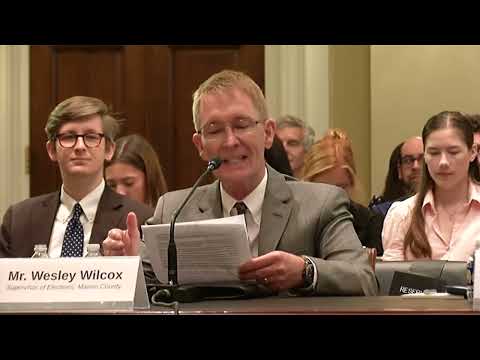
Wesley Wilcox, supervisor of elections for Marion County, Florida, told members of a House subcommittee that professionally trained poll observers can increase public confidence in election administration.
"When observers understand their role, follow the rules, and work professionally alongside election officials, they help strengthen the public confidence," Wilcox said in opening testimony. He described nearly 40 years in election administration and his role as a past president of the Florida Supervisors of Elections Association.
Wilcox traced the evolution of poll observers in Florida, saying that before 2000 watchers were commonly used in get-out-the-vote efforts but that reforms after the 2000 cycle led officials to "establish clear rules, credentials, expectations, so poll watchers could do exactly what they're supposed to do, observe the process without interfering with it."
He emphasized a sharp increase in observer numbers in recent election cycles in Marion County: "Before 2020, our high water mark in Marion County was about 50 poll watchers. In 2020, we had just over 200. In 2022, that number grew to more than 500. And during our last countywide general in 2024, we credentialed more than 1,200 poll watchers." He framed that growth as "not a challenge, that's an opportunity."
Wilcox contrasted the new public interest with historically low attendance at standard election events such as logic-and-accuracy tests or canvassing board meetings, noting many jurisdictions previously saw only two or three citizens attending. He said the recent volunteers "wanted to understand how elections work" and that officials should use the moment to educate voters.
As examples of what trained observers can see, Wilcox listed procedures intended to protect ballot integrity: how photo and signature IDs are verified in Florida, how provisional ballots are used, and how vote-by-mail ballots are processed and safeguarded. He said those firsthand views help demonstrate that only eligible citizens cast ballots and that voter databases reduce the risk of double voting.
Wilcox closed by saying the increased understanding among observers "is good for voters. It's good for election administrators, and, ultimately, it's good for our country," and he invited questions from subcommittee members.
The testimony provides a snapshot of one county official's view on expanding observation programs; Wilcox urged training and clear rules so observers support transparency without disrupting procedures. The record ends with Wilcox offering to take questions from the subcommittee.