Get Full Government Meeting Transcripts, Videos, & Alerts Forever!
Get email alerts on the State Budget And Infrastructure topic
No spam. Unsubscribe anytime.
Greater Minnesota lobbyist: bonding wins for cities but lead-line money falls short
Summary
Lily, a lobbyist representing Greater Minnesota cities, told the Madelia council that this year’s bonding bill included $1.24 billion in commitments for water, wastewater and local infrastructure but provided only $15 million for lead service-line replacement — far less than the $250 million advocates requested.
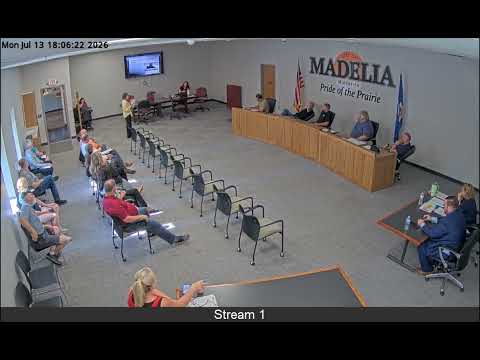
Lily, a lobbyist who said she represents Greater Minnesota cities, told the Madelia council at a workshop that the 2026 legislative session left mixed results for rural municipalities. "There’s a total package of all sources of $1,240,000,000," she said, pointing to major allocations for local water and wastewater programs and some local bridges and roads funding.
Why it matters: The package included $400 million for PFA local water and wastewater grants and $25 million set aside for local bridges, but Lily said funding for lead service-line replacement was far short of advocates’ requests — a gap that could delay scheduled construction work in 2027 and leave small cities with unmet replacement needs.
Lily said the state’s bonding bill set aside $122 million for PFA grants and loans and $47 million for local roads; she noted the Business Development Infrastructure (BDI) program received only $2 million in the final package. On lead lines, she summarized the state inventory and cost estimate: about 87,000 lead service lines had been identified and the full replacement bill statewide is about $1.5 billion. "We originally asked for $250,000,000," Lily said. "There was some lead-line money in the bonding bill, but it was only $15,000,000, which is not a whole lot."
Lily also described the session’s broader political context: a divided legislature, ongoing structural budget imbalance and an emphasis by lawmakers on passing a bonding bill and containing policy that would increase spending. She said local government aid (LGA) was protected this year and that several proposed preemptions on local zoning (including parts of a "starter home" package) largely failed after city associations and municipal coalitions pressed opposition.
Lily encouraged local officials to engage as the next session approaches, noting that 2026 is an election year with many legislative retirements and that CGMC plans outreach and a candidate packet for incoming legislators. She also offered to send attendees the exact language and application process for hospital stabilization funds and other program details.
The presentation concluded with a reminder of CGMC’s upcoming events and the Feb. 10 legislative action day in Saint Paul, which Lily said is a key opportunity for cities to press priorities.
Next steps: Lily said she would resend corrected presentation materials and provide application language for stabilization/reserve funds once available.