Get email alerts on the Public Safety Staffing topic
No spam. Unsubscribe anytime.
Hunt County prosecutors ask for new hires as caseloads and complex evidence surge
Summary
The district attorney's office presented options to add staff — up to three prosecutors, one investigator and another victim-assistance coordinator — citing rising felony filings and heavier discovery demands; commissioners asked for three years of trend data before deciding.
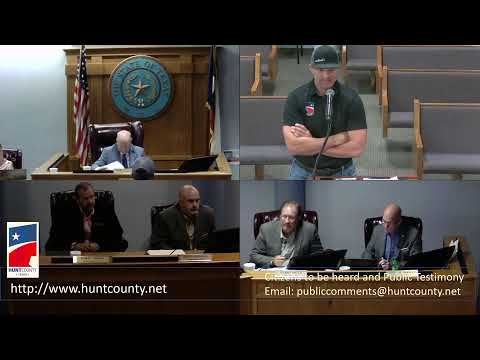
The district attorney's office told the Hunt County Commissioners Court on July 16 that it needs new staff to keep pace with a rising number of felony filings and increasingly complex evidence.
Representatives outlined four staffing options, the most expansive of which would add three prosecutors, one investigator and another victim-assistance coordinator. The office said an immediate priority is a dedicated investigator to handle intake work and to free prosecutors to prepare for major trials. “If we had an investigator to assist with intake, that would free up a lot of time for me to assist in the courts with the other prosecutors on these very big cases,” the office’s representative said.
Why it matters: Prosecutors said the county now faces many more, and more technically complicated, cases than a decade ago — including voluminous video, phone-data downloads and DNA — and that 20% of cases consume roughly 80% of staff time. The office reported a multi-year growth in filings and told the court that adding targeted positions would let existing prosecutors spend more time on the county’s most serious cases.
Commissioners pressed for concrete metrics. One commissioner asked for how many cases the office has taken in over the last three years, typical backlog and other trend data to justify the requested staffing levels. The prosecutor’s office agreed to provide a spreadsheet and said it will include measures of case intake, grand-jury workload and trial settings to show growth and backlog.
Funding context: The office discussed SB 22 state funds previously allocated to rural counties for law-enforcement and prosecutorial pay. The presenters said the county portion of SB 22—discussed during the meeting as a $275,000 allocation—has been used to hire and retain staff but that the county will have to factor SB 22 percentages into midyear salary adjustments and long-term hiring decisions.
Next steps: Commissioners asked the office to submit historical case counts and backlog figures (preferably three to five years) and to identify the minimum staffing configuration that addresses the most urgent bottlenecks. No hiring decision or formal budget vote occurred at the session.
Attribution: Statements in this article come from the district attorney’s office representatives (speaker(s) recorded in the transcript as presenting the DA request) and the commissioners who questioned them.
AI generated
The text on this page is AI generated. Summaries, highlights, analysis, and video transcripts are all produced from the original source material.
AI can make mistakes, so if you spot one, and we will fix it for everyone.
Note: the source content is unaltered by us. Any content source we link to, be it a video, an audio recording, or a document, is presented exactly as its publisher released it. That publisher is usually a government body, sometimes an individual official or another organisation.