Get Full Government Meeting Transcripts, Videos, & Alerts Forever!
Get email alerts on the Justice Reentry Child Residential topic
No spam. Unsubscribe anytime.
Director details reentry, juvenile justice and child residential reforms tied to Medicaid prerelease expansion
Summary
Crosby described funding for five new forensic assertive community treatment teams, expanded reentry and diversion programs, planned Medicaid prerelease enrollment for 90 days, and quality and assessment requirements for psychiatric residential treatment facilities.
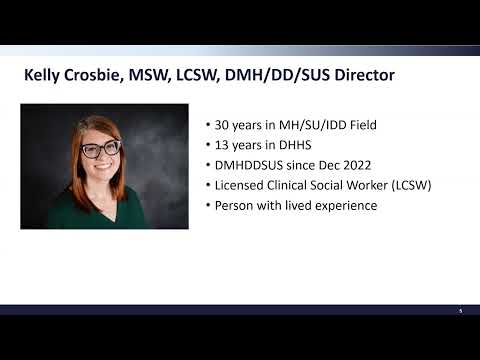
Kelly Crosby, director of the Division of Mental Health, Developmental Disabilities and Substance Use Services, described last year’s justice- and child-focused investments and the division’s plans for 2025 during the webinar.
On justice and reentry, Crosby said the division funded five new forensic assertive community treatment (FACT) teams, expanded reentry services, and awarded funds to the UNC Fit Wellness Clinic as a wraparound reentry resource. She noted an upcoming diversion-care-management awards process to expand services that help people avoid incarceration and said the division will fund transitional housing and employment supports for people returning to the community.
Crosby referred to a Medicaid enrollment change she described as a "11 15 waiver" that would allow people to enroll in Medicaid 90 days before release from incarceration; she said that prerelease eligibility will permit care management to begin while people are still incarcerated. (Transcript phrasing: "Medicaid 11 15 waiver".)
For children in out-of-home residential treatment, Crosby said the division’s goal is to prioritize community- and family-based services so placements are rare. The division is investing in environment-of-care improvements affecting about 414 youth, requiring participating residential facilities to take state-sponsored training, participate in measurement and quality-improvement activities, and ensure assessments and discharge plans for children in PRTF-level care.
Crosby said the division will pilot intensive community alternatives and brief residential care for children with complex needs, while coordinating Medicaid clinical coverage policy and rules for residential facilities. She emphasized that community-based wraparound supports, mobile crisis teams, and urgent cares are central to returning children to home settings when clinically appropriate.
The webinar was informational; Crosby asked for stakeholder advice and did not present formal votes or regulatory changes during the briefing.