Get Full Government Meeting Transcripts, Videos, & Alerts Forever!
Get email alerts on the Crisis Services topic
No spam. Unsubscribe anytime.
State highlights crisis expansions: 988 use, new beds, peer respites and a non–law-enforcement transport pilot
Summary
Director Kelly Crosby described crisis-system growth—about 140 new community crisis beds, 12 urgent cares, expanded co-responder and child mobile teams—and previewed a 2025 pilot to use non–law-enforcement transport for people needing treatment. She also highlighted 988 and a new crisis landing page.
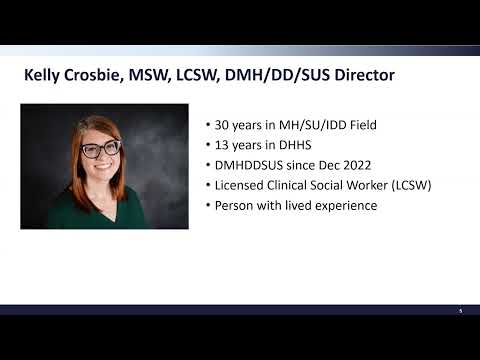
Kelly Crosby, director of the Division of Mental Health, Developmental Disabilities and Substance Use Services, outlined a series of crisis-system expansions during the webinar and previewed new tactics for 2025 to improve how people are connected to help.
Crosby said the division invested in nearly 140 new community crisis beds and 12 urgent cares last year, expanded co-responder models and added eight child-specific mobile crisis teams. She also announced additional peer respites funded for 2025 and said the division has awarded funding already for three new peer respites opening this year.
To help people find help, the division launched a crisis landing page with searchable maps for the nearest community crisis facility or urgent care, a ZIP-code tool to identify which mobile crisis team would respond, and direct links to call 988. "The first thing it can tell you is how you get connected to 988," Crosby said.
Crosby gave utilization numbers as reported in the webinar: "Almost 122,000 people called 988," and "almost 55,000 people called the Pure Warm Line," language she used to describe the scale of demand for crisis services. She also said, later in the presentation, that the division currently averages a little over 8,000 988 calls, chats and texts per month.
For 2025 the division is piloting a non–law-enforcement transportation model intended to move people humanely and safely between sites when a bed is located in another facility—an alternative to transport in police vehicles. Crosby said the pilot will include rural and urban settings and stressed it is a pilot, not a statewide policy change yet.
Crosby emphasized investments in technology to improve response: enabling 988 to identify and dispatch the nearest mobile crisis provider, track team arrivals and dispositions, and offer telehealth follow-up so callers who are ready for treatment can get timely visits. She said the division is testing telehealth integration and device links (for example, tablets for co-responder teams) to connect on-scene staff with clinicians.
No formal policy adoption or regulatory changes were decided at the webinar; the session was a public briefing on recent investments and planned pilots.