Get Full Government Meeting Transcripts, Videos, & Alerts Forever!
Get email alerts on the Transportation topic
No spam. Unsubscribe anytime.
Troy committee leans toward roundabout after debate over safety, delay and funding at busy West Main intersection
Summary
At a Committee of the Whole meeting, city staff and a consultant reviewed alternatives for the West Main (SR 41) / Experiment Farm / Stanfield intersection and presented crash, delay and cost analyses; after public comment and council questions about delays for 23,000 daily West Main drivers versus pedestrian safety, a majority of members indicated they were leaning toward a roundabout and directed further public outreach with ODOT.
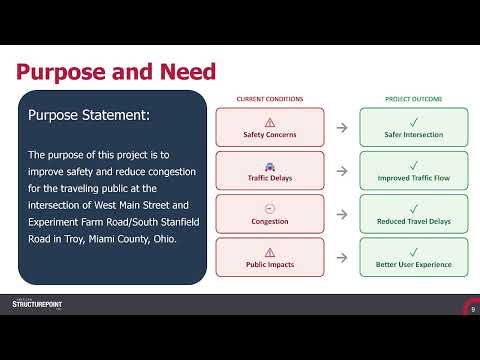
City staff and a consultant told the Troy City Council Committee of the Whole that both an improved signalized intersection and a two‑lane roundabout would cut crashes at the busy West Main (State Route 41) / Experiment Farm / Stanfield intersection, but each option would produce different tradeoffs for travel delay, pedestrian exposure and maintenance costs.
“The recommendation of American StructurePoint is the traditional roundabout for all of the reason we talk about the, you know, the improved safety, the traffic flow,” City Engineer Jill Rhodes said during the presentation, noting the model shows the roundabout shortens pedestrian crossing distance and lowers certain injury‑crash types.
The consultant and staff presented traffic volumes and safety data showing about 23,000 vehicles a day on West Main, roughly 7,300 on Experiment Farm and 9,800 on South Stanfield. Crash analysis for 2022–2024 showed rear‑end and angle collisions dominate; staff said 53% of the crashes at this intersection are rear‑end collisions compared with a roughly 22% statewide average and about 27% citywide.
Consultant modeling credited the roundabout with a meaningful reduction in some delays and injury collisions: for the northbound approach the model showed a roughly 61% delay reduction with a roundabout versus a 37% improvement for a signal upgrade, and overall crash‑reduction estimates for the roundabout were presented near 68% in the consultant’s summary. Committee members repeatedly cautioned that percentages can overstate the day‑to‑day experience: several noted the roundabout could increase delay on West Main at peak times even while improving safety and balancing flow.
“This is a $4,300,000 estimated construction regardless of the option,” one staff member said, adding that when design and engineering are included the total project figure rises (a later budget makeup in the meeting produced a $5.2 million total that incorporated estimated design costs). Rhodes and staff described a funding package that combines a federal Surface Transportation Program (STP) grant (about $2.57 million), a roughly $860,000 rural engineering grant and remaining local match from an existing tax‑increment financing (TIF) district set up around earlier development in the area.
Committee members and residents pressed for clarity on timing and community impacts. Staff said the project is on the regional TIP for the state fiscal year 2029, with bidding anticipated in late 2028 and contract language allowing successful bidders to delay physical construction until calendar year 2029 or 2030 to reduce local disruption. Several councilmembers said they were concerned about “construction fatigue” because downtown and corridor projects are underway, and some asked whether putting the work off for a few years would risk grant eligibility.
Public commenters were mixed. Troy Development Council affiliate and resident Mike Bridal emphasized preparing infrastructure for growth and cited trucking‑industry benefits for continuous flow; other residents said they feared driver confusion, pedestrian safety for older walkers, and business access impacts during and after construction. Some speakers urged more study of alternate designs (for example, a restricted continuous‑u or “superstreet” concept) or additional signal enhancements.
After extended discussion and public input, the committee took an informal straw poll: most members indicated they were leaning toward the roundabout option and directed staff and the consultant to coordinate a targeted ODOT‑review public meeting (expected in September or October) and a 30‑day comment period before any formal legislative action or awarding of design work.
Next steps outlined by staff include submitting the draft feasibility recommendation to ODOT, scheduling the ODOT‑coordinated public meeting, receiving and responding to public comments, then returning to Council with a draft final feasibility report and, if the majority so directs, an RFQ/RFP and design contract recommendation. No binding vote or ordinance was taken at the Committee of the Whole meeting.