Get Full Government Meeting Transcripts, Videos, & Alerts Forever!
Get email alerts on the Behavioral Health Technology topic
No spam. Unsubscribe anytime.
NCDHHS teams with CHESS Health to offer free Connections app statewide for recovery support
Summary
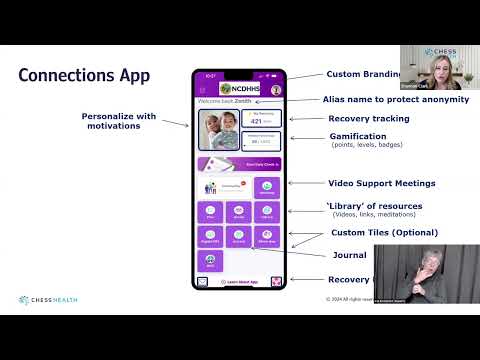
NCDHHS is funding statewide access to CHESS Health’s Connections app and companion app, which provide 24/7 peer support, moderated communities (including a teen track), in‑app CBT modules and a crisis 'recovery help' button that lists 988/911 and offers an option to connect to a peer.
The North Carolina Department of Health and Human Services is funding statewide access to CHESS Health’s Connections app and companion app to provide continuous peer support and resources for people in recovery, a presenter said during a state webinar.
Shannon Clark of CHESS Health outlined the platform’s features, saying the program is free for individuals and agencies because "the cost is being 100% covered by NCDHHS." She described Connections as part of CHESS’s eRecovery toolbox, with peer support and care-management tools designed to bridge gaps between provider visits.
Clark said the app offers an alias requirement to protect privacy, optional recovery tracking, gamification (points and digital badges), a journaling tool and a library of hundreds of resources such as TED Talks, meditations and videos. She described in‑app meetings (about 16 per week, with at least one daily) and moderated discussion communities for adults and a teen community called "Teen Scene" for ages 13–17 that requires parental consent.
The platform includes clinical and monitoring features: an inbox for messaging peers, seven digital cognitive‑behavioral therapy modules developed by Dr. Kathleen Carroll at Yale School of Medicine, and automated surveys. Clark described a daily login survey that asks, "Are you confident in your recovery today?" and a weekly BAM survey that asks about substance use in the prior seven days; if users report recent use, the app prompts whether they would like to connect to a peer.
A prominent in‑app "recovery help" button displays 988 and 911 and asks users whether they want to connect with a peer. "If an individual says, yes, I would, then a peer reaches out either via phone or text," Clark said, adding that peers can escalate cases and notify providers when follow‑up is needed.
Providers can enroll clients by creating an entity so that clients are automatically associated with that provider. Clark said enrollment options also include a public entity for individuals not affiliated with a provider and a Peer Connect community for certified peer specialists who wish to network and participate in monthly professional development.
On audience questions, Clark confirmed teens ages 13–17 are eligible with parental consent and that the system runs a back‑end job to move users into the adult community when they turn 18. She also said CHESS staff include certified peer specialists in North Carolina and elsewhere and that CHESS will provide training and virtual onboarding for provider staff who will enroll clients.
Clark urged providers and peers to contact CHESS Health for onboarding and marketing materials, including posters and social‑media content, and said slides and resources from the webinar will be posted on the community engagement site. For support and enrollment she gave an email address: support@chest.health.
The webinar concluded with a brief post‑event survey for attendees and an invitation to follow up with CHESS Health for technical assistance or partnership inquiries.