Get Full Government Meeting Transcripts, Videos, & Alerts Forever!
Get email alerts on the School Safety topic
No spam. Unsubscribe anytime.
Sen. Batch and co‑chair Billy lead school‑safety task force as panels urge more training, mental‑health staff and child‑nutrition supports
Summary
The School Safety Task Force heard three subcommittee share‑outs calling for statewide training investments, clearer mental‑health roles and policy changes to support school nutrition programs; members also flagged data gaps and requested literature‑review improvements for the governor's report.
Senator Batch opened the meeting by acknowledging “all of the challenges that we continue to see with school shootings, including our most recent shooting... across this country,” and said the governor is pressing the legislature to act on school safety while the state remains without a budget more than 90 days after the deadline.
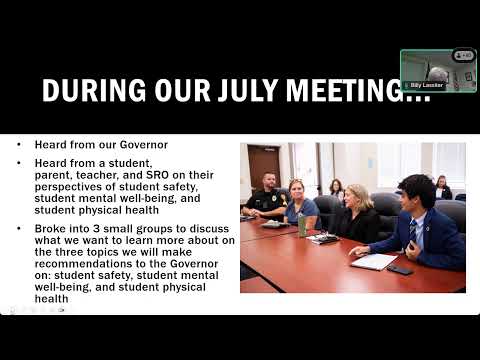
Members of the School Safety Task Force then reviewed findings from three subcommittees charged with preparing recommendations for the governor and the General Assembly. Co‑chair Billy summarized the group’s charge and the plan to fold small‑group feedback into a literature review that will be part of the governor’s report.
The student safety subgroup reported a presentation from the I Love You Guys foundation on school response, reunification and standard‑response protocols. The subgroup recommended districts ensure they have safety directors or representatives and said appropriations would likely be needed to deliver comprehensive training statewide. The presenter also noted gaps in the literature review, including requests for more detailed crime‑incident numbers and assessments of what interventions are effective at reducing gun violence in schools.
Brandy, speaking for the student well‑being subgroup, said presenters offered statewide and local perspectives and that members focused on the shortage of school‑based mental‑health staff, limits to virtual counseling compared with in‑person services and the need to clarify role boundaries among school social workers, school resource officers and psychologists. “We talked a little bit about the importance of Medicaid expansion and why that is important to remain in effect,” Brandy said, adding that the group saw uneven distribution of services across regions and asked for more tables and figures to make the literature review more usable.
The student physical health panel heard from presenters who summarized a briefing by Rachel Finley of the Department of Public Instruction and Tammy Reinhard of the Elizabeth City school system on child‑nutrition operations. The presenter explained that many school nutrition programs operate as enterprise programs that must cover costs through their own revenues, creating financial and policy constraints that the subgroup said should inform the task force’s recommendations. Members urged a holistic approach to student wellness rather than compartmentalized recommendations.
Throughout the meeting, staff and chairs emphasized that the small‑group presentations and feedback will inform a literature review and the governor’s upcoming report. Billy reminded members that the task force’s next meeting is scheduled in person for Nov. 17 from 9:30 a.m. to 12:30 p.m. at the juvenile justice office where the group previously met. Heather closed by asking members to send interim comments on the draft literature review to Elena.
No formal votes or motions were recorded during the session. The task force requested additional data, clearer role definitions for school mental‑health personnel, and consideration of funding mechanisms to expand training and staff capacity.