Get Full Government Meeting Transcripts, Videos, & Alerts Forever!
Get email alerts on the Town Hall Safety Relocation topic
No spam. Unsubscribe anytime.
Ranlo officials move to vacate aging town hall after county inspection finds structural and moisture problems
Summary
Ranlo’s town manager and a Gaston County inspector reported rapidly worsening cracks, roof ponding and moisture in the town hall; the council approved a plan to temporarily relocate operations while pursuing modular and long‑term solutions.
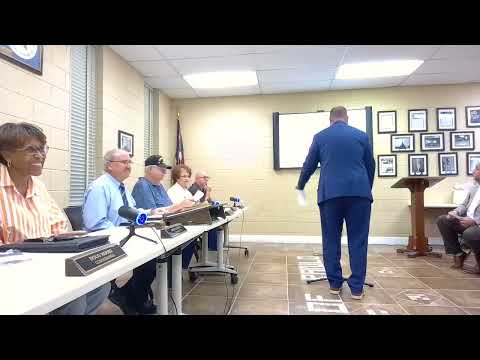
Ranlo’s town manager told the council on Sept. 12 that a county inspection and a structural engineer’s remote assessment had made clear the town hall is no longer safe for regular public occupancy, prompting the board to authorize a short‑term move to a temporary location.
The town manager, Hansen, described visible and rapidly changing cracks, water infiltration through the electrical system and sections of the double‑T roof with “chunks” that have popped out, leaving parts of the police station without power. "We have very serious problems here," Hansen said, reading from photos and describing staining, rot and water that enters the building each time it rains.
Brian Skiba, Gaston County planning and development manager, said his county inspection found numerous stress cracks, roof ponding that adds large additional loads and a pattern of deterioration that, combined with foundation issues, places the building at heightened risk. "There was enough issues throughout the building that I advised the manager that I thought we needed to get a structural engineer again ASAP," Skiba said. He recommended the town prepare to vacate the building while engineers determine remediation needs.
Hansen said he had already contacted a structural engineer who told him over the phone that the town needed to vacate the building immediately; the engineer offered to visit but told staff the evidence and photos supported an urgent relocation. "He said, 'you need to start moving out of that building,'" Hansen said, quoting the engineer.
To protect staff and maintain continuity of services, Hansen proposed a two‑step approach: move operations immediately to the Ranlo Church of God fellowship building while the town sets up a temporary operations footprint (servers, evidence storage, billing windows), then deploy modular units as an interim while the town plans a permanent replacement. Hansen said the church had offered space that would require minimal retrofitting and offered a low monthly cost as a stopgap. "It'll be a pain for a week" to close the public counter to move and set up, he said, "but it will give us time to be able to go through logistics, plan it out, move over, and then when we cut the lights on, ready to start going again."
Board members discussed logistics, statutory requirements for evidence and secure storage, utility billing, and the need to avoid a long service disruption. Skiba and the manager also flagged mold, mildew and electrical issues that would require testing and remediation and added urgency to the relocation plan.
The chair called for a motion to proceed with the manager’s plan to transition operations to the fellowship building and to continue planning for modular interim units; members voiced assent. The transcript records the board’s approval by voice but does not include a roll‑call tally on the record.
Next steps the manager outlined include completing an engineer’s on‑site evaluation, finalizing temporary facilities and logistics for evidence and server relocation, communicating with residents, and returning to the board with estimated costs and a timeline for modular procurement and the permanent building planning process.
Because portions of the building were described as losing power and showing new, rapidly advancing cracks, town officials said they would close the building to the public for an initial week to accomplish the move and set up safe operations in the temporary site.