Get Full Government Meeting Transcripts, Videos, & Alerts Forever!
Get email alerts on the Art Policy topic
No spam. Unsubscribe anytime.
Prescott council studies tightening art-donation rules, weighs curation and library backlog
Summary
At a July 14 study session, Prescott City Council reviewed a proposal to revise the city's art donation policy to favor commissioned works, heard that the library has "at least 140 plus pieces" needing cataloging, and directed staff to refine the policy for a vote on Aug. 11.
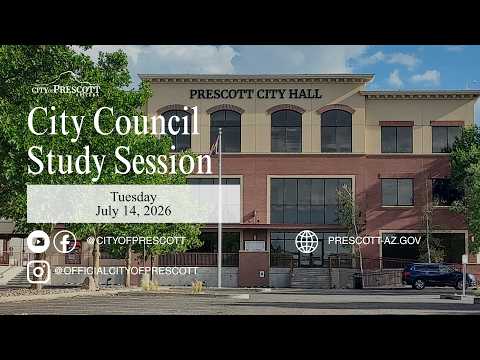
Prescott City Council on July 14 discussed revisions to the city's art donation policy that would make commissioned pieces the preferred path for future public art, while leaving procedures for existing donated works to be clarified.
Mayor Roosing opened the study session and staff explained the requested review: council had asked that the policy be revisited to consider limiting new additions to commissioned artworks rather than automatically accepting donations. The council heard from Melissa Orr, the library director, who said the library is working with volunteers to catalog its holdings and currently faces a large backlog: "So there's at least 140 plus pieces, that we're dealing with currently," Orr said, adding that many items lack documentation of ownership or location.
The library director also flagged deferred maintenance costs for visible public art, telling the council that repairing the library mural and the timeline sidewalk would cost about $60,000. That figure came up as council members weighed the fiscal implications of commissioning new, permanent works versus relying on donations or loans.
Council discussion focused on three related questions: how to treat the large stock of existing donated works; whether the city should limit new acquisitions to pieces it commissions and pays for; and who would manage curation and rotation to keep displays fresh. "This is a problem of curation," Councilman Ruby said, arguing the city should encourage rotation and citizen-led curation so the library and other display sites do not become stagnant. "You want art to be moving. You want it to be new. You want it to be fresh," he said.
Some council members raised fiscal concerns about the idea of the city commissioning (and therefore paying for) permanent art installations. "I don't think that's the mission of our city," a councilmember identified as Lois said, arguing council should prioritize essential services over using taxpayer funds to commission art and suggesting donations or loans be preferred.
Staff advised that the 2024 revision to the city's art policy already added deaccession provisions and that a single policy could contain separate treatments for donated pieces and for future commissioned works. The staff recommendation, adopted for further work at the end of the session, was to draft language that clarifies the process for handling existing donated art (including return, sale or deaccession) while setting standards for future commissioned work.
Council members repeatedly proposed expanding the role of the Civic Enhancement Committee or forming a subcommittee with artists and volunteers to handle curation, cataloging and rotation so that city staff would not bear the entire workload. Mr. Lutz, a local gallery owner who spoke during public comment, urged the council to "always look at your local resources" and emphasized supporting local artists and small businesses.
No vote was taken at the study session. Mayor Roosing said staff will revise the policy and present it to the Civic Enhancement Committee before returning the draft to council for a vote at the Aug. 11 regular meeting. The session concluded with the mayor adjourning the meeting.
Next steps: staff will update the draft policy to distinguish treatment of existing donated works and new commissioned pieces, route the draft to the Civic Enhancement Committee for feedback and return the item to council on Aug. 11 for a formal vote.