Get Full Government Meeting Transcripts, Videos, & Alerts Forever!
Get email alerts on the Infrastructure Bridge Repair topic
No spam. Unsubscribe anytime.
Andover wetlands commission approves Lake Road culvert replacement with conditions
Summary
The Andover Wetlands Commission approved permit 26-2 to replace a failing culvert on Lake Road over Cheyney Brook, conditioning the permit on contractor dewatering plans, wetlands-approved planting lists and invasive-free erosion controls; the project is grant-funded and slated for a five-month construction window starting June 2027.
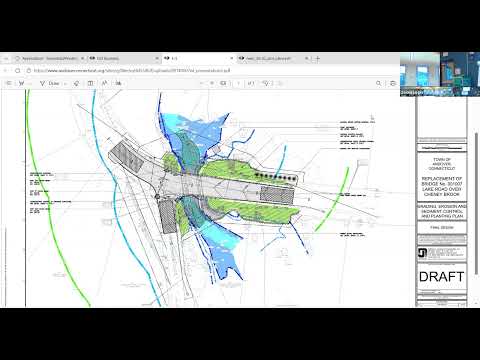
The Andover Wetlands Commission on July 7 approved permit application 26-2 to replace culvert/bridge 001007 on Lake Road over Cheyney Brook, subject to conditions intended to protect wetlands and aquatic habitat.
Howard Frommer, an engineer with David Jacobs & Associates and the town’s consulting engineer, presented the proposal to replace the existing corrugated metal pipe arch with a precast reinforced three‑sided concrete frame set on cast‑in‑place footings, with cast‑in wing walls and bridge rail. Frommer said the work would keep the existing 30‑foot roadway width and the current elevation, widen the waterway opening and remove a perched outlet that currently blocks upstream movement of fish and other aquatic organisms. He said the project has U.S. Army Corps of Engineers authorization and a DEP 401 water‑quality certification.
"We're maintaining that. Is the road elevation increasing? No," Frommer said, describing the design approach and the decision to retain the road alignment while widening the culvert opening to improve habitat connectivity.
Commissioners and residents pressed for additional safeguards. A nearby resident asked whether trees lining the road would be removed, saying she had planted them and worried they would not survive relocation. Frommer replied the contractor must replace failed plants under a statutory one‑year guarantee and that the design team would try to preserve some trees by reducing shoulder width where feasible.
Commission members requested three specific items before or as conditions of work: submission of a contractor dewatering plan that keeps dewatering upland prior to initiation of in‑channel work; a planting list showing wetland‑appropriate native species for any wetland plantings with final approval by the wetlands agent; and confirmation that any straw/hay bales used for erosion control would be free of invasive plant material. Frommer confirmed proposed erosion controls (sandbags/coffer dams, temporary bypass sleeve pipe, hay bales and sediment fence) and described riprap and reestablished stream bottom material to limit sediment transport during and after construction.
The project is grant funded through the state DOT’s State‑Local Bridge Program, with roughly 50% of cost covered by the grant, Frommer said. Construction was estimated as a five‑month period beginning in June 2027.
The commission voted to approve the permit with the stated conditions. Chair announced the motion passed after a voice vote.
What happens next: the town will require the contractor dewatering plan and final wetland plant lists as permit conditions and will follow up with affected abutters about temporary and permanent easements noted in the design. The permit approval does not authorize in‑water work to begin until the required plans are submitted and reviewed by the wetlands agent.