Get Full Government Meeting Transcripts, Videos, & Alerts Forever!
Get email alerts on the Motor Fuel Taxes topic
No spam. Unsubscribe anytime.
Tennessee Department of Revenue outlines motor fuel taxes, filing and exemptions in webinar
Summary
Department of Revenue staff explained motor fuel tax types, current rates and due dates, walked through registration and TinTAP filing procedures, and answered attendee questions on pre-collection rules, exemptions and permit renewals.
Tennessee Department of Revenue officials delivered a webinar explaining how the state levies and administers motor fuel taxes and where taxpayers and businesses can find forms, rates and filing instructions.
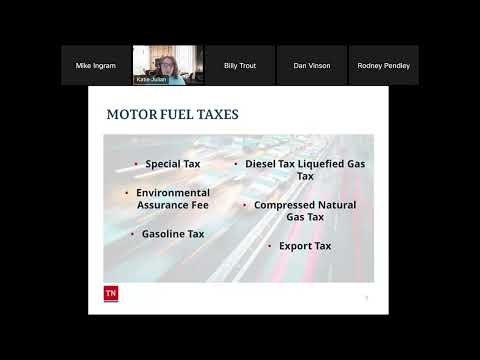
Billy Trout, of the department's Taxpayer Services and Education section, opened the session and introduced the panel, which included presenter Katie Julian and audit-division technical experts Rodney Penley and Mike Ingram. Julian led a slide presentation that listed the motor fuel taxes, statutory due dates and current rates. She said the "special tax is basically 1¢ per gallon" and quoted the environmental assurance fee as "0.004 per gallon." She also said the gasoline tax has been 26¢ per gallon since July 1, 2019 and noted a diesel rate of 27¢ per gallon.
The presentation covered other fuel levies and timing: liquefied gas is taxed at 22¢ per gallon, compressed natural gas is treated as a use tax at 21¢ and is due on the 25th of the month following activity, and an export-tax credit applies when the special tax has already been paid. Julian explained that, overall, motor fuel taxes provided about 6% of state revenue in fiscal 2022 and that 72.4% of motor fuel receipts are allocated to the state highway fund to pay for transportation projects.
On registration and filing, Julian recommended using TinTAP, the department's online portal, for registering accounts, filing returns and uploading Excel templates. She listed common licenses (suppliers, blenders, terminal operators, exporters, wholesalers and dyed-diesel retailers) and warned that missing bond information — in particular notarization of a bond — is the most frequent reason applications are delayed or rejected.
During the question-and-answer portion, Billy Trout relayed an attendee's question about the permissive supplier pre-collection election. Rodney Penley answered: "A permissive supplier ... holding inventory at an out-of-state IRS terminal ... is gonna be required to pre collect the Tennessee taxes on any shipments that have an intended Tennessee destination." Mike Ingram and Penley also noted that the monthly distributor fuel tax return is due by statute on the 20th day of the month following activity and that the filing frequency cannot be changed.
Panelists clarified exemptions and refund procedures. Julian described refund categories (exports, governmental agencies, contaminated fuels, casualty losses and others) and said refunds are requested after tax payment; casualty-loss claims must be filed within 60 days of the loss. She and Penley explained that the governmental exemption applies only to motor fuel taxes, not sales tax, and that exempt governmental entities must renew permits every four years; the department sends renewal notices about 45 days before expiration. TinTAP provides a nightly-updated list of active licensees and permit holders to help wholesalers verify exemptions.
Panelists answered other attendee questions: synthetic motor oil and lubricants are not subject to the motor fuel taxes; Tennessee will issue an exporter's license without requiring evidence of the importing state's license; and attendees who requested continuing professional education (CPE) credits will receive certificates per the webinar's CPE instructions.
The webinar concluded with contact information for motor fuels questions (audit division: (615) 532-6124; efile.questions@tn.gov; revenue.support@tn.gov), a reminder that the session recording will be posted on tn.gov/revenue and a note about the department's monthly webinar schedule. The panel encouraged attendees to use TinTAP and the help articles on the department website for detailed forms, templates and filing guidance.
The department did not take any formal votes or adopt policy during the webinar; the session was an informational presentation followed by attendee Q&A.