Get Full Government Meeting Transcripts, Videos, & Alerts Forever!
Get email alerts on the Conditional Zoning 779 Forman Siding topic
No spam. Unsubscribe anytime.
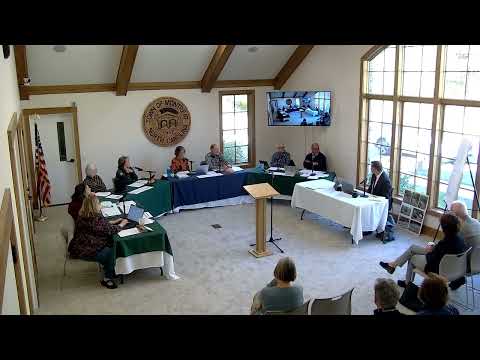
Montreat planning board hears conditional‑zoning request for 779 Forman Siding Road
Summary
The Montreat Planning & Zoning Commission reviewed a conditional‑zoning application from Wade and Susie Burns seeking R3CZ designation for 779 Forman Siding Road, focusing on reduced setbacks and stormwater mitigation the applicants say protected nearby properties during Hurricane Helene. Commissioners questioned how a pending court remand of a Board of Adjustment decision affects the legislative review; no final recommendation appears in the transcript.
The Montreat Planning & Zoning Commission on July 21 heard an application from property owners Wade and Susie Burns seeking conditional zoning (R3CZ) for 779 Forman Siding Road to formalize the site layout and setbacks for a single‑family residence. The hearing centered on two narrow issues: setback variances around a mapped ephemeral stream and whether the house’s engineered stormwater measures adequately protect downstream neighbors.
The Burns told the commission they obtained permits and variances while designing and building the house and that they engineered multiple stormwater protections, including reinforced banks, a concrete bulkhead that functions as a weir, added culverts, and roughly 3,000 gallons of underground storage with a slow release designed to reduce peak flows. “We designed the house, permitted the house, I put my stamp on everything … and given that, the planning and zoning commission should allow the zoning for that house on this site with those conditions,” Wade Burns said, arguing the measures held during Hurricane Helene.
Town staff and the town attorney framed the commission’s role. Brandon, the town attorney, said conditional zoning is a legislative process and the commission’s job is to evaluate the application and make a recommendation to the Board of Commissioners. “This is a legislative hearing,” he said; “you can vote according to what you think is best for the town,” but your decision must not be based on unlawful criteria. Alexis Baker, interim planning and zoning administrator, summarized the application materials and noted the lot is 0.26 acres and the request would reclassify the parcel from R3 to R3CZ and incorporate the submitted site plan and stormwater measures into any ordinance if approved.
Neighbors and other residents offered mixed context. Supporters said the Burns went beyond minimum requirements and that their stormwater work protected nearby properties. “We lived through Hurricane Helene … It worked perfectly,” one resident said. Opposing claims—filed by the adjacent Hamilton family and represented in submitted materials—argue that the property’s proximity to the ephemeral stream should require a 30‑foot vegetative buffer; Burns and his witnesses disputed that interpretation, saying state guidance does not impose a 30‑foot setback for ephemeral streams and that the constructed mitigations reduce hazard and downstream impact.
Commission members pressed two related legal questions: (1) what weight to give a June 2021 North Carolina Department of Environmental Quality (DEQ) determination that described the channel as ephemeral, and (2) how a superior court order remanding aspects of a Board of Adjustment decision affects a conditional‑zoning review. Staff noted the DEQ determination is in the record (the letter’s determination is effective for five years from issuance) and that the superior court remanded issues back to the Board of Adjustment; Brandon advised the commission it may review the conditional‑zoning request on legislative grounds but acknowledged that the interplay between the two tracks is legally complex.
The packet and staff materials also document that the applicant recorded an operation and maintenance agreement for the stormwater features; staff explained those agreements run with the land, authorize the town to inspect the stormwater measures (including periodic inspections), and are recorded at the Buncombe County Register of Deeds.
The commission moved into deliberations without a final decision recorded in the provided transcript. Members discussed whether to recommend approval as submitted (with the site plan and the recorded maintenance agreement becoming conditions of any ordinance), to add further conditions, or to decline to exercise jurisdiction because of the pending appeal. One commission member announced they would recuse themselves from the vote, and the board took a short break to regroup. The commission’s recommendation to the Board of Commissioners and any specific conditions or a formal vote are not included in the available transcript.
What’s next: the P&Z Commission is expected to adopt a consistency statement under state law and then vote on whether to forward a recommendation to the Board of Commissioners; the town council would make the ultimate decision on any conditional zoning ordinance.