Get Full Government Meeting Transcripts, Videos, & Alerts Forever!
Get email alerts on the Founders Adams Jefferson topic
No spam. Unsubscribe anytime.
Jim Rassenberger on Adams, Jefferson and the ‘perfect coincidence’ of July 4, 1826
Summary
At a Library of Congress program, author Jim Rassenberger discussed his new book A Perfect Coincidence, arguing the simultaneous deaths of Thomas Jefferson and John Adams mattered beyond trivia and exploring their political differences, reconciliation and the slavery contradiction in the Declaration.
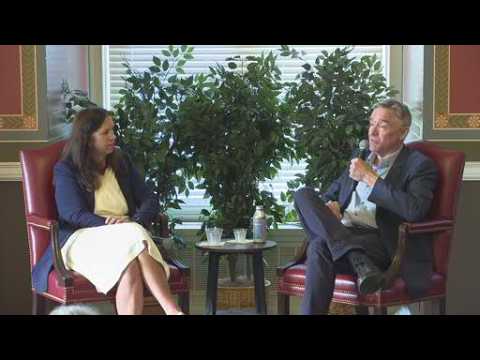
At a Library of Congress program, Jim Rassenberger, author of A Perfect Coincidence, told an audience that the simultaneous deaths of Thomas Jefferson and John Adams on July 4, 1826, were more historically consequential than mere trivia. The event was introduced by Clay Smith, the Library’s literary director, and moderated by Colleen Shogan, CEO of the civics nonprofit In Pursuit and a former archivist at the National Archives and Records Administration.
Rassenberger said the title came from a Jefferson letter to Benjamin Rush and that many Americans at the time interpreted the two deaths as a supernatural sign. "They thought it was divine providence," he said, noting that Adams and Jefferson themselves — both deists — would not have agreed with that explanation. He added that a contemporary calculation of the odds has been cited as "1 in 1,200,000,000," a striking figure Rassenberger said he could not fully verify but used to illustrate public fascination.
The author framed his book as an effort to move the event out of the realm of curiosities and into a study of its consequences. "As I was doing other research in my books, I came more and more to think this day they died together was really a pretty important event in American history," Rassenberger said, pointing to the public reaction and what followed as historically meaningful.
Rassenberger sketched contrasts in temperament and politics between Adams and Jefferson, describing Adams as "pugnacious" and Jefferson as "cool, calm" and arguing those differences shaped their ideas about government. He recounted episodes that deepened and strained their relationship — from shared diplomacy in Europe to an incendiary Jeffersonial forward to Thomas Paine’s Rights of Man that Adams read as a political slight and that helped crystallize early partisan divides.
The conversation addressed the central contradiction that sits at the founding documents: Jefferson’s phrase "all men are created equal" and his simultaneous ownership of enslaved people. Rassenberger said many founders expected slavery to disappear but were proven wrong by economic changes such as the invention of the cotton gin. He also discussed Jefferson’s relationship with Sally Hemings and the personal and social dynamics that illuminate plantation life.
In describing the final days of Adams and Jefferson, Rassenberger said the two men were not aware of the precise timing of the other’s decline; news traveled slowly. He recounted the familiar anecdote of Adams’s reported last phrase — often quoted as "Thomas Jefferson survives" — and pointed out that Adams’s final, less cinematic utterance was "Help me, child," a detail Rassenberger said complicates tidy public narratives.
During audience questions, Rassenberger was asked whether John and Abigail Adams held views that would now be considered racist. "Put simply, yes," he replied, explaining that many northerners despised slavery yet did not envision racial equality or integration. He also supported efforts to raise Adams’s public profile, noting existing commissions and foundations working on an Adams monument, and addressed a question about founders’ attitudes toward women, saying Jefferson opposed women’s political participation while Abigail Adams advocated for women’s interests.
The program closed with an invitation to meet the author at a book signing and with a reminder about a new Declaration of Independence exhibit in the building’s treasures gallery.
The talk combined account, analysis and anecdote rather than new archival revelations; Rassenberger pointed listeners to primary sources including the Founders Online resource at the National Archives for further reading. The event ended with a post‑program book signing.