Get Full Government Meeting Transcripts, Videos, & Alerts Forever!
Get email alerts on the Drinking Water topic
No spam. Unsubscribe anytime.
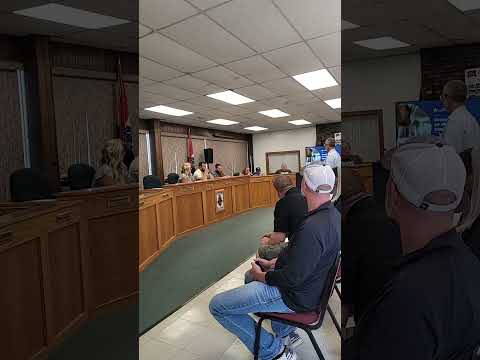
DNR official urges Eldon to sign compliance agreement that would add chlorination after E. coli positives
Summary
DNR officials told the Eldon council that a bilateral compliance agreement attached to a department letter asks the city to add disinfection after recent E. coli and coliform positives; DNR said timelines are negotiable but warned of enforcement if negotiations fail. Residents pressed for alternatives and funding options.
Lance Dorsey, the Department (DNR) chief of compliance and enforcement, told the Eldon council the agency delivered a letter that includes a bilateral compliance agreement asking the city to add disinfection — typically chlorination — to its drinking‑water system after a series of positive samples for total coliform and E. coli since December.
"We're asking you to add disinfection, and that's the main thrust of that agreement," Dorsey said, and asked the city to review the timelines and language and propose changes the agency can consider during negotiations. He said the department will entertain reasonable timeline extensions if the city demonstrates engineering and operational steps toward a permanent fix.
Why it matters: DNR described chlorination as the standard corrective action when inspectors cannot pinpoint a discrete source of contamination in distribution lines. Dalton Young, DNR supervisor for the inspection unit, explained the sampling protocol that triggered a prolonged boil advisory: after an E. coli detection the department collects repeat samples (upstream, downstream and any wells in service) and requires two consecutive business days without E. coli or total coliform to lift a boil order. Eldon obtained clean repeat days only after a temporary chlorination 'shock' procedure, Young said.
Residents and council members pressed for options other than ongoing chlorination. One resident asked whether a multiyear plan to replace distribution lines could allow Eldon to avoid permanent chlorination; DNR officials said the city may propose a project and timeline, but cautioned that for a system of Eldon's size the department often sees permanent residual disinfection as the reliable way to protect public health if the contamination source remains elusive.
DNR gave the city a negotiation window tied to the draft agreement; Dorsey and other staff said the department will accept proposed timeline adjustments but had indicated an administrative marker of roughly Aug. 13 for signing the agreement as currently drafted. DNR also warned that if the city rejects the bilateral compliance agreement the matter would move to formal enforcement — including a possible administrative order on consent and penalties for prior violations — though the agency emphasized negotiation as its preferred route.
The meeting included technical detail from DNR staff: "In order to lift the boil order you need two consecutive business days of absent samples of E. coli and total coliform," Dalton Young said, summarizing the sampling and confirmation protocol. Young and other inspectors told the council they believe the contamination was localized to distribution mains near the community center / downtown area and not the groundwater wells.
Council members and residents asked about alternatives and mitigation at the household level. Officials noted that some homeowner filtration options exist and that temporary or emergency chlorination had been used to stop ongoing positives earlier this year, but DNR staff said typical operational practice is to maintain a residual disinfectant in the distribution system once contamination has been confirmed and the cause cannot be eliminated quickly.
Next steps: DNR asked the city to review the draft bilateral compliance agreement, propose acceptable timelines and engineering milestones where appropriate, and respond to the agency so that negotiations can proceed. DNR staff pointed the council to the department's financial‑assistance team for possible low‑interest loans, grant programs and technical assistance that could support infrastructure projects if the city pursues replacements rather than continuous disinfection.
The council did not vote on the compliance document at the meeting; DNR and city staff agreed to continue negotiations and to return with proposed timeline language and engineering options.