Get Full Government Meeting Transcripts, Videos, & Alerts Forever!
Get email alerts on the Municipal Budget topic
No spam. Unsubscribe anytime.
Portland council splits over two competing plans to restore dozens of city jobs, delays final vote
Summary
Councilors debated two supplemental-budget ordinances that would restore dozens of positions and services cut in the mayor’s budget; one would spend PCEF interest to immediately restore 48 positions, the other would use general-fund contingency and later look to underspending. A procedural amendment clarifying funding sources passed; debate was continued to a later meeting.
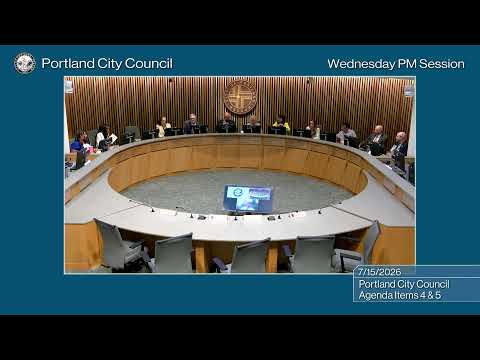
Portland City Council spent the bulk of an evening session debating two competing supplemental budget ordinances intended to restore city positions and services reduced in the mayor’s budget.
Councilor Green, sponsor of document 2026-222 known as “Save Our Services,” said the ordinance would “fund 48 critical positions the mayor proposed for elimination in his budget” and rely largely on accrued interest from the Portland Clean Energy Fund and other non‑general-fund resources. The proposal includes restoring 24‑hour staffing for three fire rescue companies, keeping 48 frontline positions across parks, transportation, water, environmental services and public-safety response, and $2.5 million in transition support for displaced employees.
Vice President Clark offered a competing measure, document 2026-223, described as a fiscally cautious alternative that would draw $9.96 million from general-fund contingency to preserve peak-hour coverage for public-service specialists, provide funding for police training and retain fire-rescue capacity. Clark said the plan also included a return of $1.75 million to a business-license tax reserve to protect the city’s fiscal stability.
The competing measures diverged most sharply over funding mechanics. Save Our Services would appropriate currently accrued PCEF interest and other non‑general-fund buckets to avoid touching general reserves; the Clark alternative would use contingency now and direct staff to look to underspending and interest accruals later. Opponents of the Clark proposal pressed that its language as introduced named the Office of Community‑based Police Accountability (OCPA) as a likely source of underspending, a step critics said would politically pressure a new civilian oversight body; supporters said the reference reflected math from prior year closeouts and that any final adjustments would require council action in the spring technical adjustment ordinance.
Budget Director Ruth Levine told council staff and members that underspending forecasts prepared in the spring and final year‑end close differ, and that preliminary year‑end numbers can include large amounts in some offices that stand up mid‑year. Levine said the preliminary underspending figure for the OCPA circulated earlier was about $12.2 million, and that the council would have to adopt any spring TAO to redirect underspent funds.
The meeting included more than two dozen public speakers. Labor leaders, park advocates and union representatives urged passage of Save Our Services, saying it would protect union jobs and voter‑approved park services. The Portland Firefighters Association, IAFF Local 43, urged restoration of the three overnight rescues, describing documented response impacts when units were offline. Members and supporters of the Community Board for Police Accountability and other accountability advocates strongly opposed measures that they said would create recurring pressure on OCPA funds, calling that an affront to the charter’s protections for independent oversight.
Council debate produced several prefiled amendments. Council President Dunphy moved Dunfee 1, which removed explicit references to OCPA and PCEF from the refill language and instead directed the city budget office to analyze underspending broadly; City Attorney’s Office deputy Heidi Brown said removing the explicit reference did not change the city’s legal authority to identify sources of funds. The Dunfee 1 amendment passed on an 8–4 vote.
Councilor Koyama Lane’s amendment to restore three specific positions — a senior‑center program position, an international‑relations position and a ceasefire coordinator — was divided into three parts; each part failed on 6–6 votes. Councilors said some items came from service‑area requests while others were offered as compromise alternatives; several speakers urged further work with labor and administration.
No final vote was taken on either underlying ordinance. After extended debate and multiple tied votes on amendments, the council recessed and scheduled continuation of the discussion at a future recessed session with second‑reading votes planned for the following week.
The council noted that only one supplemental budget may become law under state budget rules, and that any spending sourced from underspending or interest accruals will require additional council action at the spring TAO. The session closed with a commitment to continue deliberations and to give councilors and stakeholders additional time to seek compromise.