Get Full Government Meeting Transcripts, Videos, & Alerts Forever!
Get email alerts on the Battery Energy Storage topic
No spam. Unsubscribe anytime.
Indio council approves Madison Point Phase 1 with added safety conditions for battery storage and generators
Summary
The council approved entitlements for Madison Point Phase 1 (Starbucks drive‑through, retail, EV charging and a 5 MW battery energy storage system) after staff added conditions requiring engineering, NFPA/code compliance, hazard mitigation, acoustical study and AQMD permits.
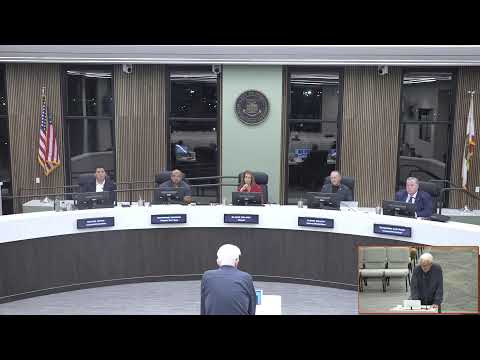
The Indio City Council unanimously approved planning entitlements for the Madison Point Phase 1 commercial project on July 15 after staff and the developer agreed to new safety and technical conditions for the project’s energy components.
Gustavo Gomez, the city’s principal planner, summarized the proposal: three commercial pads along Highway 111 and Madison Street including a Starbucks with drive‑through, a multi‑tenant retail building and a retail pad with an L3 Energy ultra‑fast EV charger paired with a 5 megawatt battery energy storage system (BESS).
Because the project includes a BESS and a novel linear generator technology, staff reported added conditions after consulting internal divisions, the fire department and outside agencies. The five new conditions require: structural designs prepared by a California‑licensed structural engineer and electrical designs by a licensed professional electrical engineer; a fire/life‑safety hazard mitigation analysis and a code analysis for stationary energy storage systems; an acoustical analysis demonstrating compliance with the city noise ordinance and program EIR thresholds; required permits from South Coast Air Quality Management District for linear generators; and contractor licensing (C‑10/equivalent) and certified electricians for installation.
Applicant representatives and technical consultants joined by phone to describe mitigations and protocols. Jim Fitzpatrick (applicant team) and Nathan McDonald (L3 Energy, on the line) said the system and installation would comply with the 2025 California codes and manufacturer standards; McDonald noted NFPA 855 and UL testing paths that have been incorporated into the new codes. Lieutenant Eric Longoria (S16), the SWAT commander, described operational benefits of an armored vehicle shared regionally and how timing for equipment availability affects festival safety; Fire Chief Brian White and county fire safety engineer David Myers explained how the department evaluates battery systems, UL test reports, hazard mitigation plans and suppression/response capacity.
Public comment raised noise and safety concerns. One resident asked for enforceable noise‑monitoring and complaint processes; staff pointed to a required acoustical analysis and conditioning enforcement under the city’s noise ordinance (Chapter 95C) and the updated municipal code enforcement tools. Fire officials explained they require UL testing, hazard analyses and NFPA/equivalent documentation; David Myers said the County’s fire engineering review requests UL 9540/UL 9540A or equivalent testing and hazard mitigation analyses prior to permitting.
With those conditions included in the staff recommendation, the council moved, seconded and unanimously approved resolutions 10600, 10601 and 10602 for the planning review, conditional use permit for the drive‑through and the tentative tract map (see actions). Councilmembers suggested continued monitoring and clear permitting checks for contractor certifications during plan review.
The approval includes required plan checks, permits from South Coast AQMD for emissions from linear generators, and conditions requiring the project to meet California Building and Electrical Code requirements and NFPA guidance prior to construction.