Get Full Government Meeting Transcripts, Videos, & Alerts Forever!
Get email alerts on the Land Use Rezone topic
No spam. Unsubscribe anytime.
Larimer County planning panel recommends denial of LifeQuest campus rezoning over water, infrastructure and plan-fit concerns
Summary
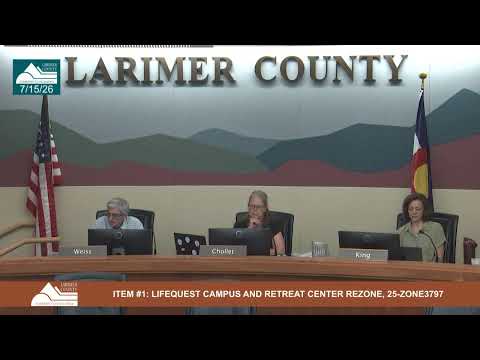
The Larimer County Planning Commission voted July 15, 2026 to recommend denial of a proposed rezoning of roughly 235 acres for the LifeQuest campus (file 25-zone-3797), citing the county comprehensive plan, proximity to Loveland’s Green Ridge reservoir and unresolved infrastructure and water-quality safeguards.
The Larimer County Planning Commission voted July 15, 2026 to recommend that the Board of County Commissioners deny a rezoning application from LifeQuest Global to rezone about 235 acres from Open to Rural Plan Development (RPD) for a campus and retreat center (file 25‑zone‑3797).
The commission’s action follows testimony from county staff and multiple referral agencies who cited conflicts with the county’s comprehensive plan and expressed concern that the project’s proposed densities and uses would be inconsistent with the area’s Mountain Foothills framework. County staff recommended denial, saying the proposal “does not meet the requirements of the Larimer County land use code or the comprehensive plan.”
Why it mattered: Loveland utilities staff and other water experts told commissioners the project site lies within the watershed that drains to Green Ridge Reservoir, Loveland’s primary drinking-water supply for about 80,000 customers, and warned that stormwater, nutrient loading and contaminants of emerging concern create nontrivial long-term risks. City representatives urged the commission to weigh those risks heavily when considering a permanent zoning change.
What was proposed: Applicant materials and staff presentations described a campus with resort-style lodging, cottages and an 80–100 room lodge, approximately 140 units in a “living laboratory” apartment building, 30–65 detached units depending on build‑out, 10–15 cottages, workforce housing (targeting roughly 25% of staff), and supportive facilities including a learning laboratory and event spaces. The team said the project could create about 150 permanent jobs, year‑round programming and tax revenue for Larimer County, and proposed shared water and wastewater infrastructure with the neighboring Sunrise Ranch.
Arguments from the applicant: LifeQuest counsel Claire Havelda told the commission that the county’s comprehensive plan is advisory rather than regulatory and argued the proposal meets the purpose of an RPD by offering public benefits and creative design. Engineering consultant Don Toronto (TST) said the project’s technical memo shows impacts are “de minimis” and that properly designed best-management practices (BMPs), monitoring and enforceable long‑term maintenance would protect water quality. The applicant offered to accept conditions of approval and enter MOUs with Sunrise Ranch and to comply with the TST recommendations.
Concerns from referral agencies and residents: Loveland water officials, including Water Resources Manager Todd Hamlin, and Loveland’s source-water staff urged denial, saying the rezoning would allow concentrated residential and commercial infrastructure immediately adjacent to the reservoir and that BMPs reduce but do not eliminate risk. Loveland emphasized proximity (about 250 feet in portions of the site), contaminant travel time, and the city’s long-standing source-water protections. Global Utilities and other commenters noted past compliance issues at the existing wastewater plant and stressed that engineered BMPs require ongoing operation and maintenance.
Commissioners’ deliberations: Commissioners who voted for the denial said the concept is interesting but that the proposed location, the lack of binding infrastructure commitments, unanswered technical details at the rezoning stage, and inconsistency with the comprehensive plan outweighed the potential benefits. Chair Lisa Chollet said the location and risks “far outweigh any demonstrated benefit,” and several commissioners said a rezone that remains with the land would create a perpetual, hard-to-reverse set of obligations and potential risks for future county stewards.
Formal action: Commissioner Shelby King moved that the commission recommend denial of the Emissaries of Divine Light/LifeQuest rezone (file 25‑zone‑3797) to the Board of County Commissioners; Commissioner John Weiss seconded. The roll call recorded Weiss — yes; Slutsky — yes; King — yes; Chollet — yes. The motion carried and the commission forwarded a recommendation of denial.
What comes next: The Planning Commission’s recommendation will be transmitted to the Larimer County Board of County Commissioners, which will take the final action. Staff and referral agencies noted that many technical issues (detailed water quality review, engineering design and permitting) would be addressed at later, site‑specific review stages if a different body later approved the rezoning.
Notes on sources and attribution: Quotes and technical assertions are sourced to the meeting record: applicant counsel Claire Havelda for legal/plan arguments; Don Toronto (TST) for the project water analysis; Todd Hamlin and Loveland utilities staff for source-water objections; county planner Justin Curry and planning manager Asksmaker for staff findings and recommendations. Where a speaker did not provide a name in the transcript, the article uses the functional role used in the record (for example, county staff titles).