Get Full Government Meeting Transcripts, Videos, & Alerts Forever!
Get email alerts on the Rubbish Ordinance topic
No spam. Unsubscribe anytime.
Larimer County holds first reading of ordinance to expand rubbish enforcement
Summary
At a July 13 land-use hearing the Larimer County Board took first reading of an ordinance implementing House Bill 26-1239, expanding county authority to remove rubbish from adjacent rights-of-way, extending warrant timelines to 30 days and adding civil penalties and injunctive relief; a second reading is set for Aug. 10.
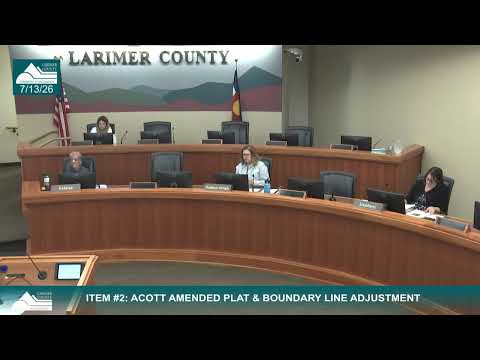
Larimer County’s Board of County Commissioners on July 13 held a first reading of an updated county rubbish ordinance that implements changes made by House Bill 26-1239 and broadens local enforcement tools.
Amy White, Larimer County’s code compliance supervisor, summarized the changes during a staff presentation, saying the new language extends the period to execute an entry-and-seizure warrant from 10 days to 30 days and "expand[s] right of way authority" so the county can compel property owners to remove rubbish from public right-of-way immediately adjacent to a property when the condition originates from that property. She said administrative cost recovery was increased and that the county can collect additional fees for court-ordered cleanups.
Why it matters: the ordinance changes shift enforcement power and remedies available to the county, adding civil penalties, the ability to seek injunctive relief, and stronger lien and collection measures against property owners who fail to abate violations after notice.
What the ordinance would do: according to White’s reading of the draft, the county may seek court-ordered civil penalties "of not less than $100 nor more than $2,650 per day of the violation," and each day of continued violation would be treated as a separate offense. The ordinance would also allow the county to assess abatement costs as a lien against the property and add a 10% charge to cover inspection and incidental expenses. The draft excludes industrial tracts of 10 or more acres and agricultural land currently in agricultural use, citing CRS section 30-15-401.2.
Public process and schedule: White explained the next steps for the ordinance after first reading. "We now publish it for 10 days in a newspaper of general circulation. If we don't receive any comments from then, we will come back for a 2nd reading on August 10," she said, adding that the county would publish an adopted ordinance for 30 days and it would become effective 30 days after the conclusion of that publication period.
Public comment: Nicholas Castell, who identified himself during the public-comment period, questioned whether the county should have the authority described in the draft and raised property-rights concerns, saying the measure could be used to penalize private property owners. County attorney Frank Haug and Chair Jody Shab McNally responded that the county's authority comes from state statute and reminded speakers of the hearing rules.
What was not decided: the board did not adopt the ordinance at this meeting; the hearing served as a first reading and informational presentation. A second reading is scheduled for Aug. 10, at which point the board could move toward final adoption if the ordinance proceeds through the remaining publication steps.
Sources: staff presentation and ordinance language read into the record by Amy White; public-comment statements made during the hearing.