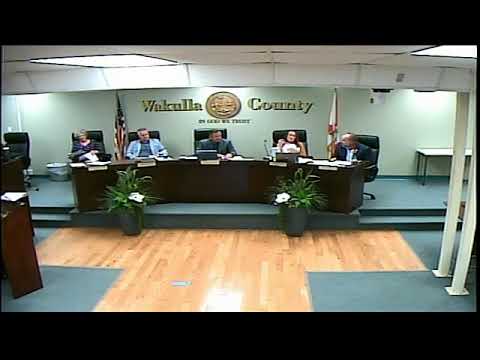
Wakulla County commissioners direct staff to propose 7.7-mill rollback and hold solid-waste fee; fire-fee decision deferred
Summary
In a second budget workshop, commissioners examined the $249.7 million preliminary 2026–27 budget, weighed options to cut the millage and keep fees flat, and gave staff direction to report a proposed millage of 7.7 mills while holding the solid-waste assessment steady; the fire-fee adoption was left for the meeting proper.
Wakulla County commissioners signaled consensual direction at a July workshop to report a proposed millage rate of 7.7 mills to the property appraiser and to hold the county’s solid-waste fee at its current level while deferring a final decision on the fire-fee increase to the meeting proper.
Kimmy Kelly, presenter for the county’s budget team, told commissioners the preliminary gross budget for fiscal year 2026–27 is $249,656,336 and that removing $26,700,000 in interfund transfers produces a net budget of $222,937,991. Kelly said roughly two-thirds of the net budget — about $148,000,000 — is grant-funded and that the county-funded portion stands at about $74,580,000.
Why it matters: commissioners said the board must balance taxpayer relief with maintaining funds for essential services. Kelly warned that new transparency legislation (House Bill 1329) will require the county to perform a 10% budget-cutting exercise and to publish more downloadable budget data beginning next year, changing how staff prepares budget documents.
The board’s choices
Kelly presented two late scenarios requested by commissioners: reducing the millage to 7.7 mills and holding the fire and solid-waste fees flat (Plan 1), or lowering the millage further to 7.5 mills (Plan 2). She estimated a $306,334 ad-valorem revenue reduction from moving to 7.7 mills and an $810,174 reduction at 7.5 mills. Kelly said stacking a millage cut with holding the fire fee flat would increase the county’s planned cash drawdown and could consume most of the county’s projected excess fund balance.
On the solid-waste fund, Kelly said a proposed increase from about $214 to $222 would generate just over $3,500,000; the Waste Pro contract for the coming year is estimated at $3,100,000, leaving a projected year-end fund balance of roughly $539,000 versus a policy target of $929,000. Kelly said keeping the solid-waste rate flat would reduce the planned fund buildup but would not be a “huge impact” on the fund in the near term.
On fire funding, Kelly summarized a rate-study-based residential assessment proposed at $277 per unit that would create a $6,100,000 assessment but yield about $4,720,000 in budgetable revenue after exemptions; she said the county would apportion 92% of that revenue to operations and 8% to capital and projected the fire fund could make roughly half of its recommended transfer to the general fund under the proposed increase. Kelly warned that, if the board holds the fire fee flat, the county could choose to defer the budgeted $412,000 transfer from the fire fund to the general fund, shifting pressure to general revenues.
Commissioners’ view
Chair (speaker 1) and other commissioners repeatedly stressed caution about cutting too deeply, particularly given long-term increases in public-safety personnel costs and pensions. One commissioner said the 7.7-mill option was acceptable as a stopgap, while expressing concern that holding the fire fee flat today could force larger residential increases later if statewide property-tax reform passes.
The board’s direction
After discussion, commissioners indicated consensus to report a proposed millage of 7.7 mills to the property appraiser and to keep the solid-waste assessment flat; they left the fire-fee resolution and the exact residential rate to be considered at the Board of County Commissioners meeting later that night. Kelly noted preliminary rate resolutions set a published maximum on TRIM notices but can be lowered later; raising a published number later would require reprinting notices at additional cost.
Next steps and context
Kelly said staff will return with updated year-end projections after incorporating third-quarter financials and any revised constitutional-officer requests. The third budget workshop is scheduled for Aug. 17, the tentative budget will be set at a Sept. 8 public hearing and final adoption is expected in late September. Kelly also reminded commissioners that many large infrastructure projects are grant-funded and that lines of credit are used to cash-flow reimbursable grants.
The workshop adjourned with no citizen comments.
AI generated
The text on this page is AI generated. Summaries, highlights, analysis, and video transcripts are all produced from the original source material.
AI can make mistakes, so if you spot one, and we will fix it for everyone.
Note: the source content is unaltered by us. Any content source we link to, be it a video, an audio recording, or a document, is presented exactly as its publisher released it. That publisher is usually a government body, sometimes an individual official or another organisation.